India Develops Eco-Friendly Road Material
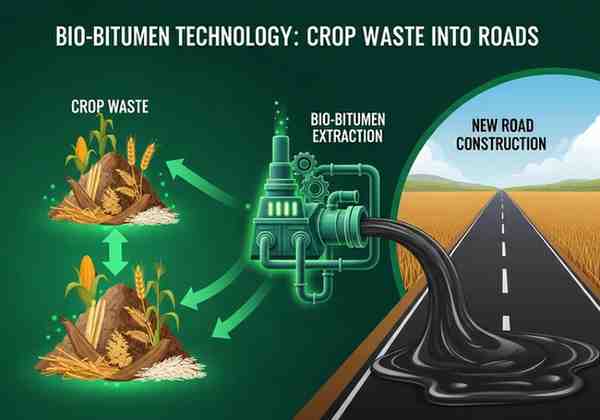
India has taken a major step towards sustainable infrastructure with a new bio-bitumen technology developed by Council of Scientific and Industrial Research. This innovation converts agricultural waste into a cleaner alternative to traditional road construction material.
How the Technology Works
The technology has been developed by CSIR-Central Road Research Institute and CSIR-Indian Institute of Petroleum. It uses crop residue and other biomass materials, which are processed through a thermochemical method to create bio-bitumen. The final product performs similarly to petroleum-based bitumen in strength and durability.
Connecting Farmers with Infrastructure
This innovation links agriculture with infrastructure development. Farmers can sell crop residue instead of burning it, helping reduce air pollution. It also creates an extra source of income for farmers while supporting cleaner practices.
Environmental and Economic Benefits
Bio-bitumen reduces dependence on imported crude oil and lowers carbon emissions. It supports the idea of a circular economy by turning waste into useful products. The material is suitable for road construction, including national highway projects.
Exam-Focused Points
-
Bio-bitumen: Made from lignocellulosic biomass (crop residue)
-
Developed by: CSIR-CRRI and CSIR-IIP
-
Process: Thermochemical conversion
-
Benefit: Reduces stubble burning and pollution
-
Use: Alternative to petroleum-based bitumen
Importance for Policy and Industry
The transfer of this technology to industries marks an important step in using scientific research on a large scale. It shows how innovation can solve multiple problems—pollution, waste management, and resource dependency. The initiative supports India’s goals of sustainable development and self-reliance.
Month: Current Affairs - March 31, 2026
Category: Infrastructure, Agriculture