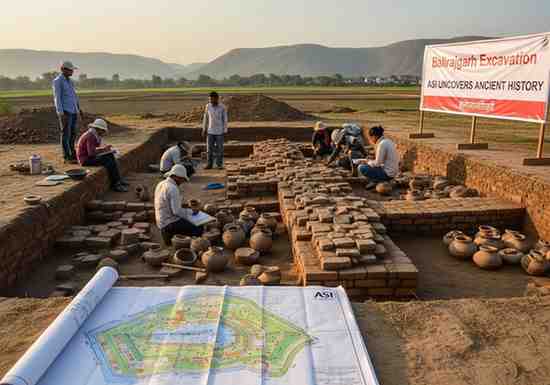
ASI Begins Fresh Excavation at Balirajgarh
The Archaeological Survey of India has started a new phase of excavation at Balirajgarh in Bihar’s Madhubani district. The aim is to explore deeper historical layers and understand ancient civilisation in eastern India.
Location and Historical Importance
Balirajgarh is located in Madhubani, Bihar, and holds both mythological and historical value. It is linked to King Bali from Indian traditions and is believed to have been an important centre of the ancient Videha Kingdom. This makes the site significant for studying early governance and culture.
Findings from Past Excavations
Earlier excavations conducted between 1962 and 2014 revealed remains from different historical periods. These include the Northern Black Polished Ware phase, as well as the Sunga, Kushan, Gupta, and Pala periods. Such discoveries show that the site was continuously inhabited for many centuries.
Protection and Preservation
Balirajgarh was declared a protected site in 1938 under the Ancient Monuments Preservation Act, 1904. This status ensures proper conservation and scientific study. The current excavation is expected to provide more information about ancient settlements, administration, and daily life.
Exam-Focused Points
-
Location: Madhubani district, Bihar
-
Linked to: Videha Kingdom and King Bali (tradition)
-
Cultural layers: Sunga, Kushan, Gupta, Pala periods
-
Protected since: 1938 under 1904 Act
-
ASI: Established in 1861 by Alexander Cunningham
Role of ASI in Heritage Conservation
The Archaeological Survey of India is the main organisation responsible for protecting India’s historical sites. It conducts excavations, preserves monuments, and manages archaeological research. Its work helps in understanding India’s rich cultural and historical heritage.
Month: Current Affairs - March 31, 2026
Category: History, Culture, Archaeology