Indian Private Sector Achieves In-Orbit Imaging Milestone
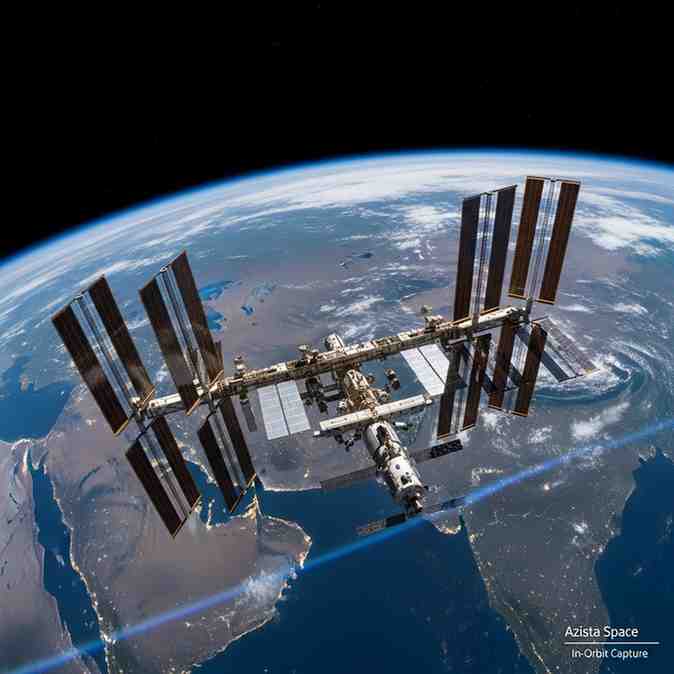
India’s commercial space ecosystem has registered a notable technological advance after aerospace firm Azista Space successfully photographed another orbital asset using its indigenously developed satellite. The company’s earth observation platform, ABA First Runner (AFR), obtained images of the International Space Station (ISS), marking a pioneering achievement for an Indian private enterprise in space-domain monitoring.
Complex Tracking Demonstration in Low Earth Orbit
The operation involved observing a rapidly moving target located several hundred kilometres away. AFR tracked the ISS at an estimated separation of about 250–300 km, capturing multiple frames under challenging lighting and viewing conditions. The exercise validated onboard guidance, tracking algorithms and electro-optical sensors designed to identify and follow objects against the bright backdrop of Earth’s horizon.
Mission Background and Satellite Performance
The 80-kg satellite was deployed into orbit during a rideshare launch aboard a Falcon 9 rocket as part of the Transporter-8 mission in 2023. After extended operations in space, the platform conducted two separate imaging passes of the ISS, successfully collecting a series of frames at an approximate ground sampling resolution of around 2.2 metres. The mission team reported full mission success across both attempts.
Strengthening Space Situational Awareness Capabilities
The demonstration contributes to India’s evolving space situational awareness (SSA) framework, which focuses on detecting, tracking and predicting the motion of satellites and debris. As India’s orbital fleet continues to expand across communication, navigation and earth-observation services, precise monitoring helps reduce collision risks, safeguard national assets and support strategic decision-making during periods of congested orbital activity.
Momentum for India’s Commercial Space Ecosystem
Azista Space’s accomplishment highlights growing domestic expertise in satellite bus engineering, optical payload design and onboard data processing. Operating one of Asia’s private satellite manufacturing facilities, the company’s work reflects the broader policy shift encouraging private participation alongside national missions. Such demonstrations strengthen confidence in indigenous capabilities while expanding opportunities for collaborative projects with public space agencies.
Exam-Focused Points
-
Space Situational Awareness (SSA) involves tracking satellites, debris and other orbital objects.
-
Low Earth Orbit extends up to roughly 2,000 km above Earth’s surface.
-
The International Space Station orbits at an altitude of about 400 km.
-
Rideshare launches allow multiple satellites to be deployed on a single rocket mission.
-
Private sector participation is increasingly central to India’s expanding space technology ecosystem.
Month: Current Affairs - February 09, 2026
Category: Space Technology | Internal Security