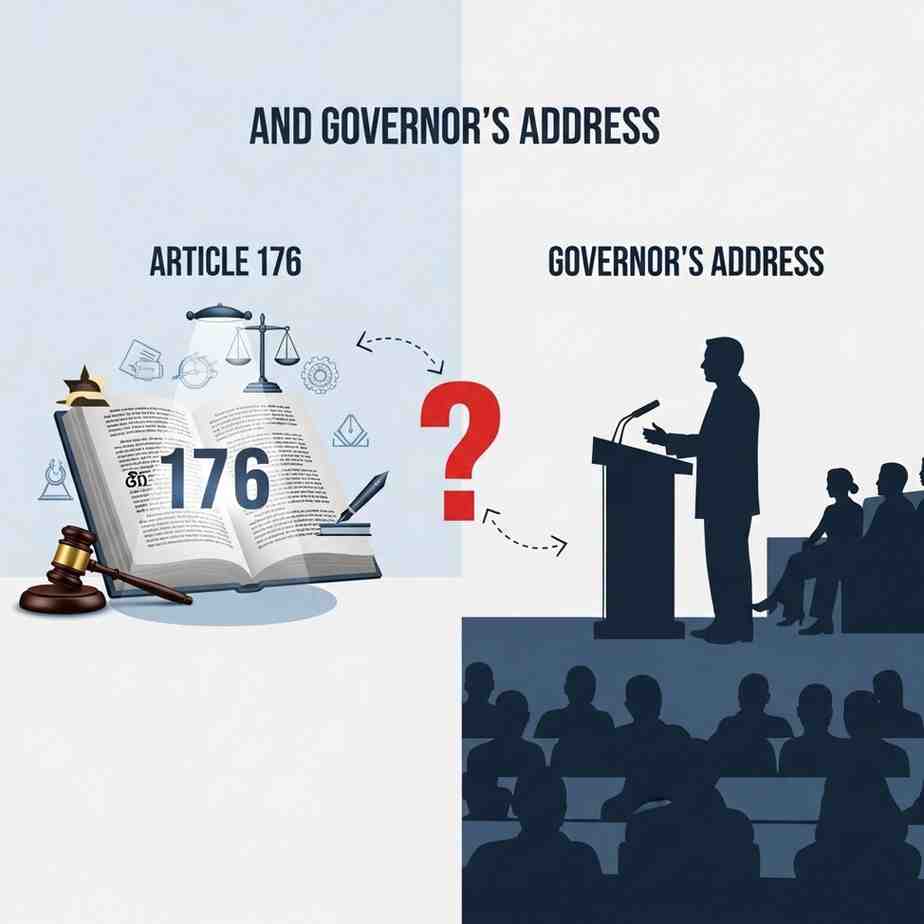
Governor Walkouts During Assembly Sessions Raise Constitutional Questions
Recent incidents involving Governors staging walkouts or selectively curtailing their inaugural addresses in Opposition-ruled states such as Karnataka, Tamil Nadu and Kerala have reignited a constitutional debate on the scope of gubernatorial discretion in India. Legal scholars and constitutional experts argue that these actions challenge the established understanding of the Governor’s role as a neutral constitutional head within a parliamentary system.
Constitutional Mandate Under Article 176
Article 176(1) of the Indian Constitution clearly states that the Governor shall address the Legislative Assembly, or both Houses where applicable, at the beginning of the first session each year. This address is not meant to reflect the personal views of the Governor. Instead, it formally presents the policies, priorities and programmes of the elected State government , drafted by the Council of Ministers.
Experts emphasise that the use of the word “shall” makes the provision mandatory, leaving no room for discretionary omission, alteration or refusal. Any deviation, they argue, undermines the principle of responsible government.
Supreme Court on the Limits of Discretion
Judicial pronouncements have repeatedly narrowed the discretionary space of Governors. In Shamsher Singh vs State of Punjab (1974) , a seven-judge Bench held that Governors must function on the aid and advice of the Council of Ministers, and public criticism of government policy by a Governor amounts to a constitutional impropriety.
This position was reinforced in the Nabam Rebia vs Deputy Speaker (2016) judgment, where the Supreme Court clarified that the Governor’s powers under Articles 175 and 176 are executive functions , not discretionary or legislative ones. The Court warned that any expansion of discretionary authority could destabilise the federal balance.
Governor’s Role in Parliamentary Federalism
The Constituent Assembly debates provide important context. Dr B R Ambedkar envisioned the Governor as a constitutional sentinel , not an alternative power centre. The office was designed to function above partisan politics, ensuring continuity and constitutional propriety rather than political intervention.
Allowing Governors to selectively perform mandatory duties, critics argue, risks converting a ceremonial office into a political instrument, thereby weakening legislative sovereignty and democratic accountability.
Imporatnt Facts for Exams
-
Article 176 mandates the Governor’s address to the State Legislature
-
Governor acts on the aid and advice of the Council of Ministers
-
Shamsher Singh case (1974) restricted Governor’s public criticism of state policy
-
Nabam Rebia case (2016) held Articles 175 and 176 to be executive, not discretionary
Federal Implications and Possible Judicial Review
Following recent walkouts, reports indicate that the Karnataka government may approach the Supreme Court to seek clarity on whether such actions violate constitutional provisions. Critics contend that truncated or abandoned addresses dilute legislative authority and erode long-standing constitutional conventions.
The controversy highlights a persistent challenge in Indian federalism: balancing the constitutional position of Governors with the supremacy of elected governments
Month: Current Affairs - January 27, 2026
Category: Indian Polity | Constitution of India