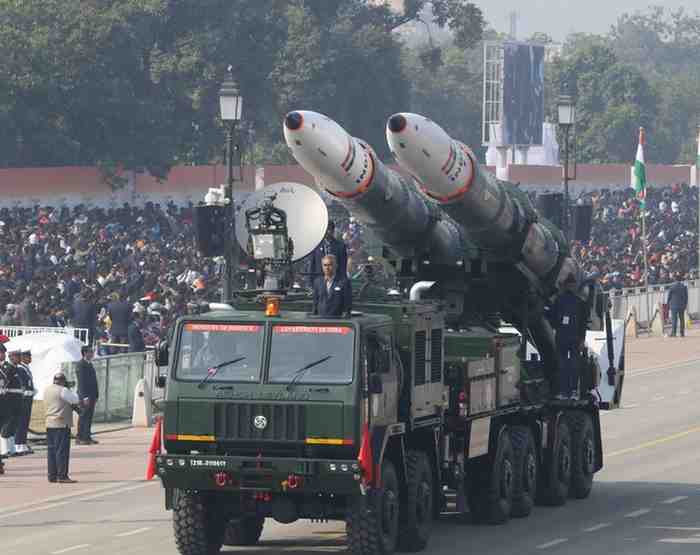
Army Day 2026: India’s Missile Arsenal and the Evolution of Strategic Deterrence
India marks Army Day every year on January 15 to honour the legacy of military leadership and professionalism that has shaped the Indian Army since Independence. As the nation commemorates the appointment of Field Marshal K. M. Cariappa as the first Indian Commander-in-Chief in 1949, attention has also turned to the missile systems that now form a critical pillar of India’s national security architecture.
Army Day and the Modern Security Landscape
Army Day is not only a moment of remembrance but also an occasion to reflect on how the Indian Army has adapted to evolving security challenges. In today’s strategic environment, missile capabilities are central to deterrence, rapid response, and escalation control. Indigenous missile development has enabled India to safeguard its sovereignty across land, air, and maritime domains while reducing dependence on external suppliers.
Strategic Ballistic Missile Capability
India’s long-range deterrence rests on a mature ballistic missile programme. The Agni series forms the backbone of this capability.
-
Agni-5 , with a range exceeding 5,000 km, provides intercontinental reach and strengthens strategic deterrence.
-
Agni-Prime (Agni-P) represents a new generation of medium-range ballistic missiles, with improved accuracy, lighter weight, and canisterised launch for faster deployment and enhanced survivability.
These systems support India’s doctrine of credible minimum deterrence by ensuring assured retaliation capability.
Cruise Missiles and Precision Strike Power
Precision strike capability is reinforced through advanced cruise missiles designed for flexibility and accuracy.
-
BrahMos , a supersonic cruise missile, is deployable from land, sea, and air platforms. Extended-range variants nearing induction significantly expand India’s conventional strike envelope.
-
Nirbhay , a long-range subsonic cruise missile, is designed for terrain-hugging flight and deep penetration, enabling strikes against high-value targets while evading enemy air defences.
Together, these systems provide India with conventional deterrence options below the nuclear threshold.
Exam-Focused Key Points
-
Army Day is observed annually on January 15 .
-
The Agni missile series forms the core of India’s ballistic missile deterrent.
-
BrahMos is a supersonic cruise missile with multi-platform launch capability.
-
India follows a doctrine of credible minimum nuclear deterrence .
Air, Naval and Defensive Missile Systems
India’s missile ecosystem spans all domains of warfare:
-
In air combat, Astra Mk-1 and Mk-2 beyond-visual-range air-to-air missiles enhance the Indian Air Force’s engagement capability at long distances.
-
At sea, the K-15 Sagarika submarine-launched ballistic missile supports India’s sea-based deterrent, ensuring a
Month: Current Affairs - January 15, 2026
Category: Missile Technology, Strategic Deterrence