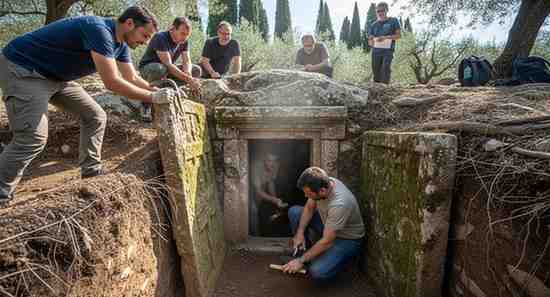
Rare Undisturbed Etruscan Burial Chamber Found at San Giuliano
Archaeologists in Italy have uncovered a sealed 2,600-year-old tomb belonging to the Etruscan Civilization , offering valuable insights into a culture that existed centuries before the rise of the Roman Civilization . The burial chamber was discovered at the San Giuliano Archaeological Site , where archaeologists found the remains of four individuals along with more than one hundred ritual objects. Since the tomb remained sealed and untouched for over two millennia, it provides a rare opportunity to examine authentic Etruscan burial customs and social organisation.
Discovery at San Giuliano
The San Giuliano site lies about 70 kilometres northwest of Rome and was once home to a thriving Etruscan settlement built on a plateau surrounded by an extensive necropolis. Excavation work is part of the San Giuliano Archaeological Research Project , which involves universities, the Virgil Academy in Rome and Italian heritage authorities. Since 2016 , researchers have documented hundreds of rock-cut tombs across the surrounding landscape.
Artefacts Inside the Burial Chamber
Inside the chamber, archaeologists discovered four skeletons carefully arranged on carved stone beds, indicating a deliberate burial ritual. The tomb also contained more than 100 grave goods , preserved exactly as they were placed during ancient funeral ceremonies. These artefacts included ceramic vessels, iron weapons, bronze ornaments and silver jewellery such as hair accessories. Etruscans often buried such items with the deceased because they believed these objects would serve them in the afterlife.
Significance of the Discovery
The find is particularly important because the tomb remained sealed beneath a stone slab for centuries. Many Etruscan burial sites in Italy were looted either in ancient times or later historical periods. The untouched condition of this chamber allows researchers to examine burial traditions from the 7th century BCE in exceptional detail. Preliminary analysis suggests the skeletons may represent two male-female pairs, although scientific testing will be required to confirm relationships.
Exam-Focused Key Points
-
Etruscan Civilization: Flourished in central Italy between the 8th and 6th centuries BCE .
-
Main regions included Tuscany, Umbria and Lazio .
-
Necropolis: Large ancient cemetery or burial ground.
-
Etruscan culture influenced early Roman religion, architecture and city planning .
-
The tomb contained four skeletons and more than 100 burial artefacts .
Month: Current Affairs - March 09, 2026
Category: History & Archaeology