Overview
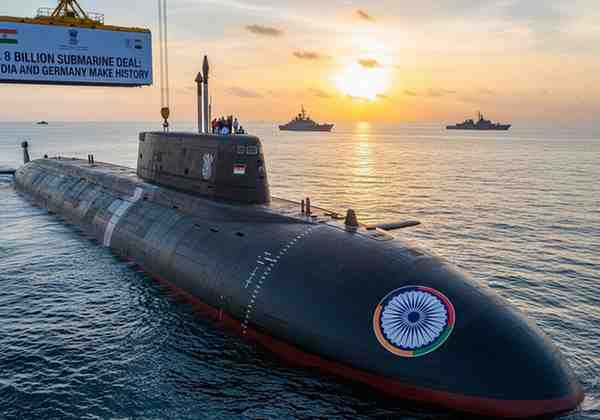
India is close to signing a $8 billion deal with Germany for six advanced submarines. The deal includes full technology transfer and local construction. These HDW Class 214 submarines will have Air-Independent Propulsion (AIP) technology, allowing them to stay underwater for weeks without surfacing.
A Long Wt Nearly Overai
After nearly 20 years of waiting, India is finally on the verge of signing one of its biggest defence deals. The government has approved a ₹70,000 crore ($8 billion) agreement with Germany to build six modern submarines right here in India. This is not just about buying new boats. It is about bringing world-class submarine technology to India and building a self-reliant defence industry. The project is called Project 75-I , and it is the future of India's underwater navy.
What is Project 75-I?
Project 75-I is a programme to build six next-generation conventional submarines for the Indian Navy. These submarines will be equipped with Air-Independent Propulsion (AIP). They will also have modern weapons and advanced sensors. The project was first approved almost two decades ago. But it got stuck in delays. Now, with the Finance Ministry's approval, the deal is moving quickly to the Cabinet Committee on Security (CCS) for final sign-off. If all goes as planned, the contract will be signed by the end of March 2027.
The Partners: Mazagon Dock and ThyssenKrupp
The submarines will be built by Mazagon Dock Shipbuilders Limited (MDL) in Mumbai. MDL is India's premier warship-building company. The German partner is ThyssenKrupp Marine Systems (TKMS) . TKMS is a world leader in non-nuclear submarines. Together, they beat the only other competitor, a Spanish-French combine, to win this project. This partnership is a perfect match. It combines German submarine technology with Indian manufacturing skills.
The Submarine: HDW Class 214
The new submarines are based on the HDW Class 214 design . This is a proven, world-class submarine. It is 65 metres long and can carry a crew of 27 people. It has eight 533 mm torpedo tubes and can fire anti-ship missiles. But its biggest feature is Air-Independent Propulsion (AIP) .
What is AIP and Why Does It Matter?
Air-Independent Propulsion is a game-changing technology. To understand it, think of a submarine as a person swimming underwater. A normal diesel submarine is like a swimmer who must keep popping his head above the water to breathe. His engine needs air to run. Every time he surfaces, he risks being spotted by the enemy.
AIP changes everything. It works like a diver carrying his own oxygen tank. The submarine carries its own oxygen and fuel inside sealed tanks. It combines them to make electricity quietly, deep underwater, without ever reaching up for air. With AIP, a submarine can stay hidden for two to three weeks at a stretch . Without it, a submarine can stay underwater for only a few days. This makes AIP submarines very hard for enemies to detect. They become silent hunters of the deep.
Technology Transfer: A Historic First
This is perhaps the most important part of the deal. Germany has never agreed to transfer such comprehensive submarine-building technology to a country outside its closest European allies. Under the contract, TKMS will transfer the submarine's full design and technology to India
Month: Current Affairs - May 31, 2026
Category: IndiaGermanySubmarineDeal