Oldest Reptile Skin Fossil Sheds Light on Early Land Evolution
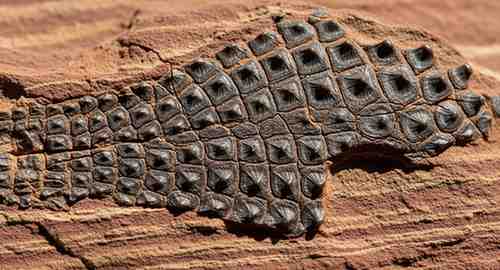
Scientists have discovered a 289-million-year-old fossilised reptile skin in Oklahoma, making it the oldest known example of preserved reptilian skin. Unearthed at the Richards Spur cave system, the find significantly extends the known timeline of skin evolution and provides rare insight into early terrestrial life.
Discovery at Richards Spur Cave
The fossil was found by collectors Bill and Julie May in a limestone quarry at Richards Spur. It was later examined by a research team led by Ethan Mooney. The tiny fragment is believed to belong to an early Permian reptile, likely related to Captorhinus aguti. Its exceptional preservation has made it a landmark discovery in paleontology.
Unique Preservation Conditions
The extraordinary preservation of the fossil is attributed to specific environmental conditions at Richards Spur. Rapid burial by fine clay protected the tissue, while low oxygen levels slowed decomposition. Additionally, natural oil seepage played a crucial role by effectively preserving soft tissues. These conditions enabled the survival of the epidermis in three-dimensional detail—an extremely rare occurrence in the fossil record.
Features of the Ancient Skin
The fossil shows small, non-overlapping scales with a pebbled texture, resembling those of modern reptiles like crocodiles. The structure suggests flexibility similar to snakes and worm lizards. These features indicate that early reptiles had already developed durable and adaptable skin suited for survival in terrestrial habitats.
Evolutionary Significance and Future Research
Dating back to the Early Permian period, the discovery provides critical evidence of how early amniotes adapted to life on land. The development of protective, water-resistant skin was essential for survival outside aquatic environments. This finding bridges a major gap in vertebrate evolution and opens avenues for re-examining other fossils for preserved soft tissues.
Exam-Focused Points
-
Fossil age: ~289 million years (Early Permian period) .
-
Location: Richards Spur, Oklahoma .
-
Associated species: Captorhinus aguti .
-
Preserved layer: Epidermis (outer skin layer) .
-
Preservation aided by low oxygen + oil seepage .
-
Shows pebbled, flexible reptilian scales .
-
Provides insight into early terrestrial adaptation of amniotes .
Month: Current Affairs - March 18, 2026
Category: Science & Technology