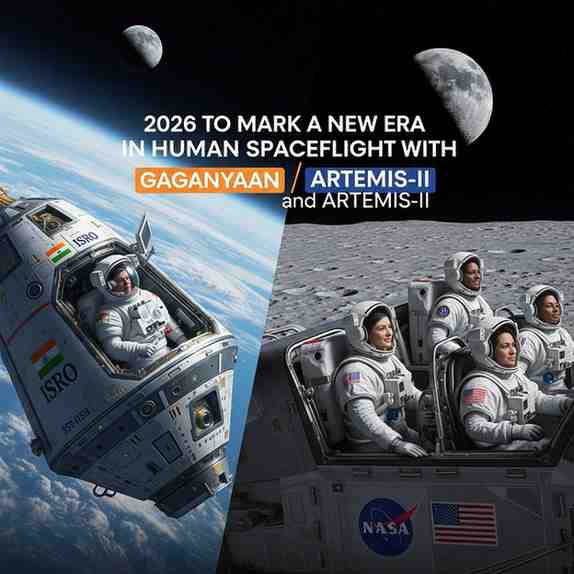
2026: A Pivotal Year for Human Spaceflight
The year 2026 is shaping up to be a landmark moment for global human space exploration, with India and the United States preparing two transformative missions. India’s Gaganyaan G1 and NASA’s Artemis-II reflect rising technological ambition and a shift towards a more multipolar space order.
India’s Gaganyaan G1 Mission
India is set to conduct its first uncrewed orbital test mission , Gaganyaan-G1, tentatively scheduled for March 2026 . Launched aboard the human-rated LVM3 rocket , the mission will place a crew module into low-Earth orbit (300–400 km) . A humanoid robot named Vyommitra will be onboard to simulate astronaut activities and monitor crew-centric systems.
Strategic Goals of Gaganyaan
The G1 mission aims to validate key human-spaceflight technologies, including life-support systems, crew safety mechanisms, communication links, atmospheric re-entry, and parachute-assisted sea recovery . Successful completion will move India closer to its first crewed mission and position it among a small group of nations with indigenous human-spaceflight capability. The programme also supports India’s long-term ambitions for space stations and commercial human missions.
NASA’s Artemis-II Mission
Globally, NASA’s Artemis-II , scheduled no earlier than February 5, 2026 , will send four astronauts aboard the Orion spacecraft on a lunar flyby. Launched using the Space Launch System , the mission will carry humans beyond low-Earth orbit for the first time since Apollo-17 in 1972 , travelling over 5,000 nautical miles beyond the Moon .
Important Facts for Exams
-
Gaganyaan is India’s first human spaceflight programme
-
Vyommitra is a humanoid robot for uncrewed missions
-
Artemis-II is NASA’s first crewed deep-space mission since 1972
-
Both missions test life-support and crew safety systems
Month: Current Affairs - January 02, 2026
Category: Space Technology