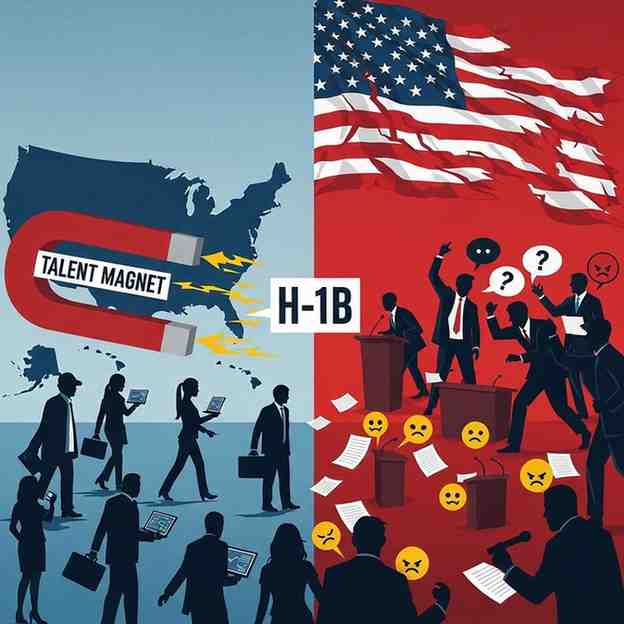
charged rhetoric.
What began as a policy debate has, in many cases, morphed into social resentment. Harassment and xenophobia directed at Indian professionals underscore how easily economic anxieties can be redirected toward identifiable groups.
Industry silence and narrative capture
Strikingly, this transformation has faced little public resistance. U.S. technology firms, Indian IT companies and industry associations have largely confined themselves to quiet lobbying. The absence of a robust public defence has allowed a simplified, often distorted narrative to harden.
Even Indian American political voices have paid a price for dissent. When Vivek Ramaswamy defended the H-1B programme in late 2024, he faced backlash from his own base, illustrating how politically toxic the issue has become.
Beyond policy: reputational damage
Even if the H-1B programme survives legally, its reputational damage may outlast any single administration. Once a policy is stigmatised, enforcement hardens, scrutiny intensifies and tolerance erodes. Employers grow cautious; regulators presume bad faith.
Future administrations may find it politically difficult to champion high-skilled immigration unless economic conditions shift dramatically. Executive orders can be reversed; narratives cannot.
What the debate truly represents
The H-1B controversy is no longer only about visas. It reflects a deeper question about America’s self-image: whether it still sees global talent as a source of strength or as an internal threat. In recasting high-skilled immigration as an enemy within, Trump’s second term risks altering not just policy, but the idea of the United States as the world’s foremost destination for ambition and innovation.
Month: Current Affairs - January 02, 2026
Category: