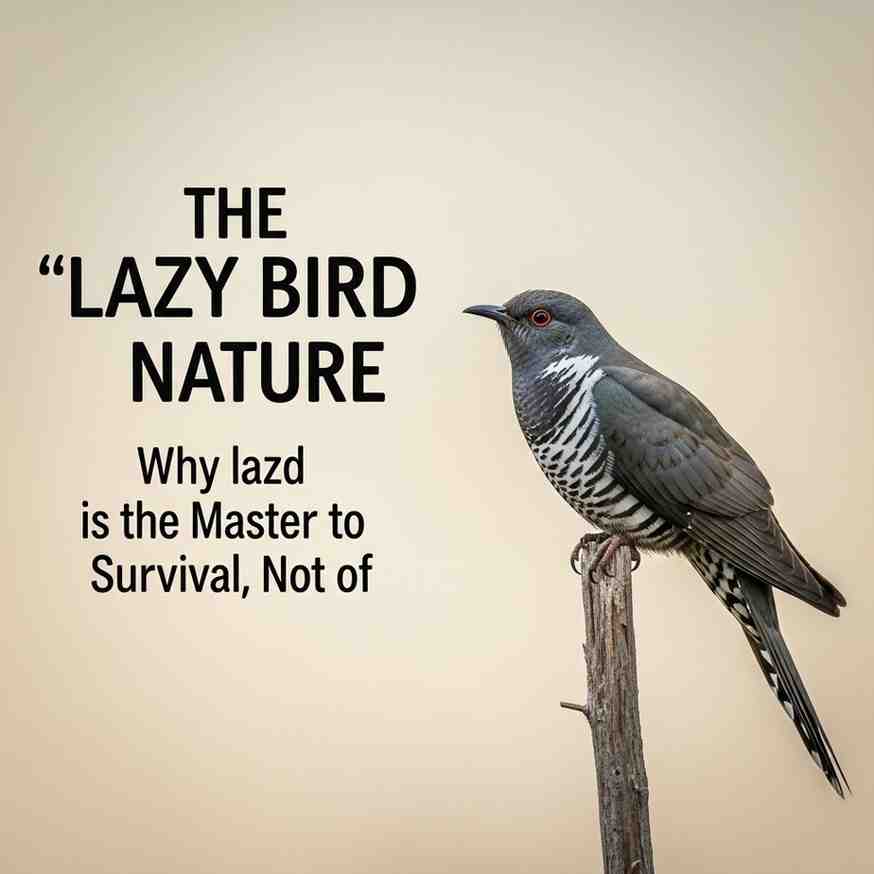
In popular imagination, laziness is often associated with inactivity, lack of effort, or avoidance of responsibility. When this human idea is applied to the natural world, it can be misleading. A classic example is the cuckoo, a bird widely referred to as the “Lazy Bird”. The label arises from the cuckoo’s refusal to build nests or raise its own young. Yet, far from being indolent, the cuckoo represents one of nature’s most sophisticated evolutionary strategies, demonstrating how survival often depends more on intelligence than on hard work alone.
Why the Cuckoo Is Called the Lazy Bird
The cuckoo, known in India as the koel, earns its reputation because it does not engage in what most birds do: nest-building, egg incubation, and parental care. Instead, it lays its eggs in the nests of other birds and leaves the responsibility of raising its offspring to unsuspecting hosts.
From a superficial viewpoint, this behaviour appears lazy. However, in biological terms, it is a highly refined adaptation known as brood parasitism , a survival strategy that allows the cuckoo to conserve energy while maximising reproductive success.
Understanding Brood Parasitism
Brood parasitism is a phenomenon in which one species exploits another by relying on it to incubate eggs and rear offspring. In the case of the cuckoo, the female carefully selects a host nest—often belonging to birds such as crows, warblers, pipits, or robins.
When the host bird is temporarily absent, the cuckoo removes or destroys one of the host’s eggs and replaces it with her own. The cuckoo egg is remarkably similar in size, colour, and pattern to the host’s eggs, reducing the chances of detection. The host bird, unaware of the substitution, incubates the egg and later feeds the cuckoo chick as if it were its own.
A Ruthless Yet Effective Strategy
The cuckoo’s survival strategy becomes even more striking after the egg hatches. The cuckoo chick usually emerges earlier than the host’s chicks. Soon after hatching, it instinctively pushes the remaining eggs or nestlings out of the nest. This ensures that it receives all the food brought by the foster parents.
Despite often growing much larger than the host bird, the cuckoo chick continues to be fed tirelessly. Within weeks, it matures and flies away, leaving behind foster parents that unknowingly devoted their entire reproductive effort to raising another species.
This behaviour may appear cruel, but in evolutionary terms, it is extraordinarily effective. By avoiding parental investment, cuckoos can lay more eggs across multiple nests, increasing their chances of genetic survival.
Egg Mimicry: Nature’s Deception at Work
One of the most remarkable aspects of cuckoo biology is egg mimicry. This resemblance is not accidental. Female cuckoos are genetically predisposed to lay eggs in nests of the species that raised them.
For example, a cuckoo raised by crows will target crow nests as an adult. If a cuckoo mistakenly lays an egg in the wrong nest, the host bird is likely to recognise the foreign egg and reject it. Over generations, natural selection has fine-tuned this mimicry, making cuckoos some of the most successful deceivers in the animal kingdom.
Are Cuckoos Unique in This Behaviour?
The cuckoo is not alone in using brood parasitism. Several other species have evolved similar strategies:
-
Cowbirds in North America lay eggs in the nests of songbirds.
-
Honeyguide birds in Africa exploit other species to raise their young.
-
Black-headed ducks in South America practice obligate brood parasitism.
-
Even outside birds, the cuckoo catfish tricks other fish into caring for its offspring.
These examples show that what humans label as “laziness” is often an efficient evolutionary solution to environmental challenges.
Lazy or Intelligent? Rethinking the Label
Calling the cuckoo lazy reflects a human moral judgement rather than scientific reality. In nature, success is measured by survival and reproduction, not effort or fairness. The cuckoo excels on both counts.
By outsourcing parental care, it conserves energy, reduces risk, and maximises reproductive output. This strategy allows cuckoos to thrive across diverse habitats and continents, proving their evolutionary success.
Lessons from the Cuckoo
The cuckoo challenges conventional ideas about effort and productivity. It demonstrates that survival does not always favour the hardest worker, but often the most adaptable strategist. Nature rewards efficiency, not morality.
In a broader sense, the cuckoo reminds us that intelligence in the natural world can be subtle, indirect, and unconventional. What appears to be laziness may, in fact, be the result of millions of years of evolutionary refinement.
Conclusion
The cuckoo, popularly known as the “Lazy Bird”, is anything but lazy. Its reliance on brood parasitism represents one of the most ingenious survival strategies in nature. By redefining effort through adaptation rather than labour, the cuckoo stands as a powerful example of how evolution favours innovation over exertion. In the wild, success belongs not to those who work the hardest, but to those who learn how to work smartest.
Month: Current Affairs - Dec 30, 2025
Category: