Streamlined regulatory procedures and facilitation of business.
Availability of shared facilities and testing infrastructure.
The promotion of ancillary industries and services.
Delhi can promote ATMP and OSAT units to become a part of the global supply chain of semiconductors without the complete cost of fabrication.
Employment creation and Skill Ecosystem.
Creation of quality employment is one of the key aims of the policy. Skilled engineers, researchers and technicians can be employed in semiconductor design, R&D and advanced packaging that are skill-intensive industries that can generate jobs.
The educational ecosystem that is already well established in Delhi such as IITs, IIITs and privates can be utilized to create a consistent stream of skilled professionals. Specialized skilling programs will play a pivotal role in closing the gap between educational education and the needs of the industry.
Consistency with National Semiconductor Mission.
The policy will be supporting the India Semiconductor Mission that will develop a complete semiconductor ecosystem in the nation. As the states, such as Gujarat and Tamil Nadu, are oriented towards fabrication and manufacturing, the orientation of the state of Delhi towards design and innovation establishes a balanced approach to the national strategy.
This type of regional specialisation has the ability to improve efficiency, decrease duplication and speed up the overall semiconductor capabilities in India.
Challenges and Constraints
Delhi semiconductor push has a potential but suffers a number of challenges:
- Inadequate space to provide industrial infrastructure on a large scale.
- High cost of operations relative to other states.
- Demand consistent policy from the long-term to attract long-term investment.
- International competition with semiconductor centers.
To overcome these limitations, it will be necessary to have co-ordinated policy implementation, close Centre-State liaison and constant contact with industrial players.
Conclusion
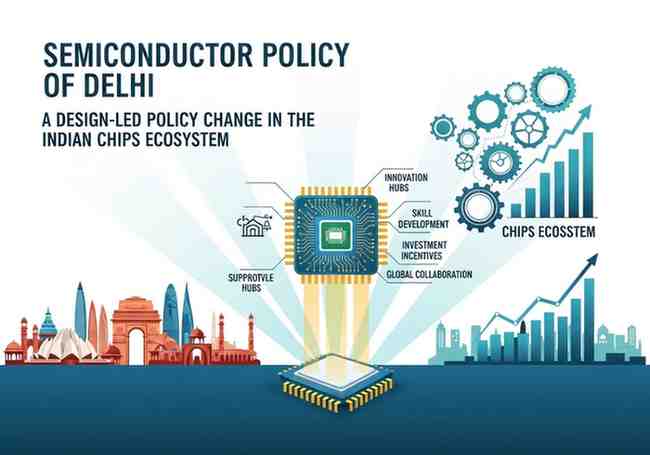
The suggested semiconductor policy by Delhi can be seen as a strategic reorientation of India in the pursuit of technological autonomy. The city is capitalizing on the natural advantages it has to create a competitive niche in the global semiconductor ecosystem by concentrating more on design, innovation and advanced packaging instead of capital-intensive fabrication.
When well done, this strategy can ensure the attraction of international investment as well as the creation of high-skill jobs, and India can be placed better in the value chain of critical technologies. Over time, the success of Delhi might show that in the semiconductor game, intellectual capital might be as decisive in the race as industrial capacity.
Month: Current Affairs - April 20, 2026
Category: