Silverpit Crater Confirmed as Ancient Asteroid Impact Site in the North Sea
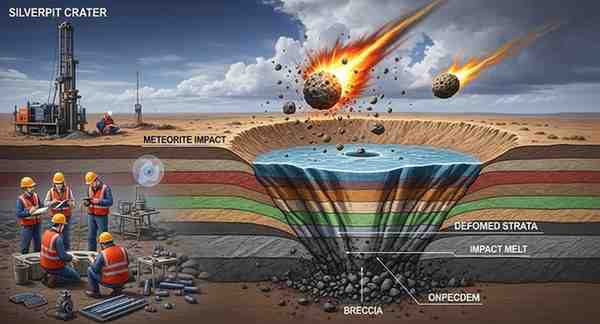
Scientists have confirmed that the Silverpit Crater in the North Sea was created by a powerful asteroid collision millions of years ago. By examining geological samples from the area, researchers identified minerals formed only during high-energy space impacts. The discovery supports earlier hypotheses that the structure hidden beneath the seabed is a genuine meteorite impact crater rather than a formation created by normal geological activity.
Location and Initial Discovery
The Silverpit Crater lies roughly 700 metres below the seabed in the North Sea , about 80 miles from the coast of Yorkshire in the United Kingdom .
The structure remained buried under thick layers of sediment for millions of years. It was first identified in 2002 during seismic imaging surveys conducted for offshore oil and gas exploration. The circular underground structure revealed by seismic data prompted scientists to investigate whether it might be an ancient meteorite impact site.
Evidence of a High-Velocity Asteroid Impact
Researchers estimate that the crater formed approximately 43–46 million years ago when a large asteroid struck the seabed at extremely high speed. Such collisions release enormous energy, generating intense pressure and heat that alter surrounding rocks.
Analysis of rock samples from a nearby drilling site revealed the presence of Shocked Quartz and Feldspar . These minerals develop distinctive internal structures only during high-pressure events such as meteorite impacts, confirming the origin of the crater.
Geological Structure of the Crater
The Silverpit Crater measures about three kilometres in diameter and is surrounded by concentric fault rings extending up to 20 kilometres across.
These circular fractures formed when shock waves from the impact travelled through surrounding rocks. The crater also exhibits features commonly seen in hypervelocity impact craters , including a round shape and central structural uplift.
Scientific Significance
The confirmation of the crater’s origin provides valuable evidence for understanding Earth’s history of asteroid impacts. Impact structures help scientists study how large collisions shape planetary surfaces and alter geological formations.
Because the crater is well preserved beneath sediment layers, it offers a unique opportunity to examine the long-term geological effects of ancient asteroid impacts. Research on such structures also improves knowledge about potential hazards from near-Earth objects.
Exam-Focused Points
-
Silverpit Crater is located beneath the North Sea near the Yorkshire coast of the United Kingdom .
-
The crater was discovered in 2002 during seismic surveys for oil exploration .
-
It formed about 43–46 million years ago due to an asteroid impact .
-
Shocked Quartz is a key geological indicator of meteorite impacts.
-
Impact craters provide important evidence for studying planetary geology and asteroid hazards .
Month: Current Affairs - March 15, 2026
Category: Science & Technology / Earth Science