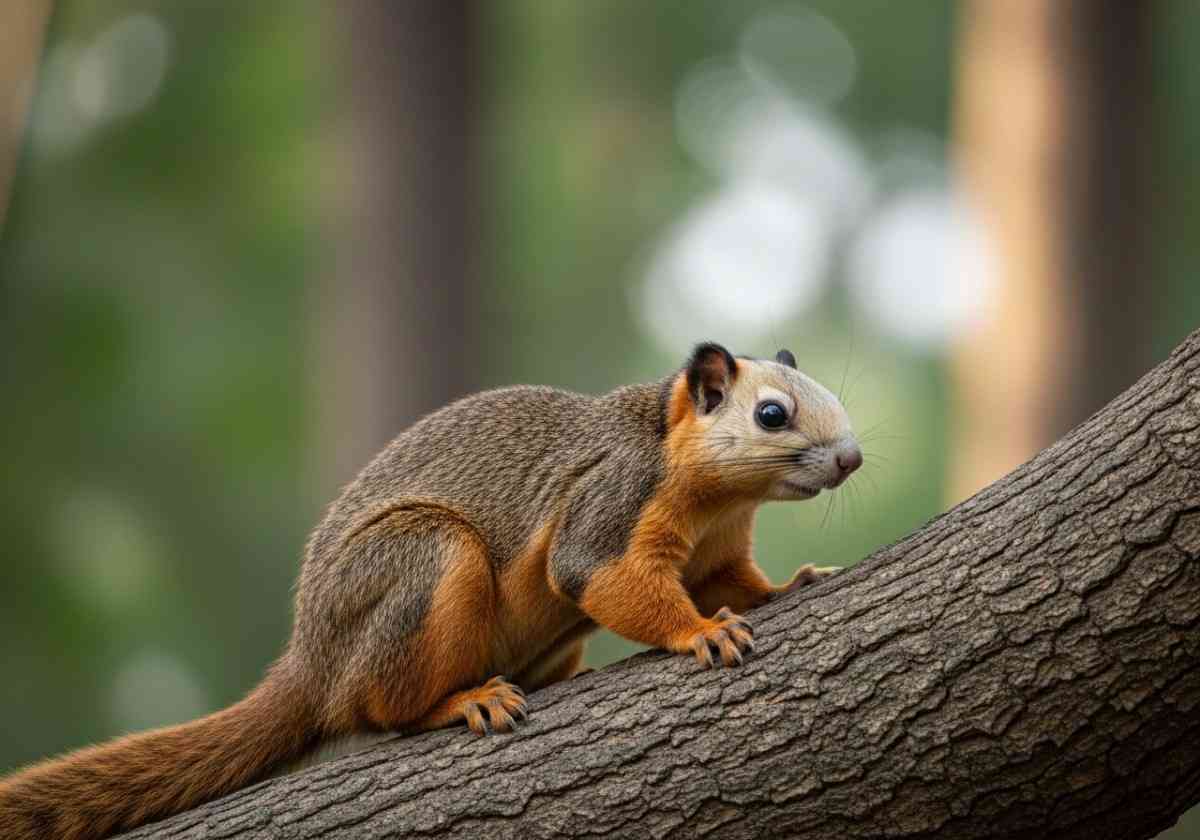
inside tree holes, often with its tail wrapped around its body.
It builds no nest; it simply uses natural hollows in trees.
Its closest relatives are other giant squirrels found in Southeast Asia.
Conclusion
The recent spotting of the Giant Malabar Squirrel in Chhattisgarh’s Barnawapara forest is a happy event. It shows that this beautiful, endemic animal may be more widespread than we thought. It also highlights the importance of protecting our forests. Every sighting of a rare animal is a reminder that nature still holds surprises for us. Let us hope that the Devpur forest area continues to provide a safe home for the ‘Shekru’ for many years to come.
Exam-Focused Points
-
Common names: Giant Malabar Squirrel, Indian Giant Squirrel, Shekru (Maharashtra).
-
Scientific name: Ratufa indica .
-
Endemic to: India (found nowhere else).
-
Primary habitats: Western Ghats, Eastern Ghats, Satpura Range.
-
Forest types: Tropical deciduous, semi‑deciduous, wet evergreen.
-
Elevation range: 180 – 2,300 metres.
-
Latest sighting: Devpur forest area, Barnawapara forest, Chhattisgarh (2026).
-
Size: Body 254–457 mm; tail longer than body.
-
Colours: Black, brown, deep red, white/cream patches.
-
Behaviour: Arboreal, solitary, freezes when threatened.
-
Jumping distance: Up to 6 metres.
-
Diet: Fruits, flowers, nuts, seeds, bark, insects.
-
IUCN status: Least Concern.
-
State animal of Maharashtra.
Frequently Asked Questions (FAQ)
Q1: Is the Giant Malabar Squirrel found only in India?
A: Yes. It is endemic to India. You will not find it naturally anywhere else in the world.
Q2: What is the scientific name of the Giant Malabar Squirrel?
A: Ratufa indica .
Q3: Where was it recently spotted in Chhattisgarh?
A: In the Devpur forest area of Barnawapara forest. This is a wildlife sanctuary in Balodabazar district.
Q4: What colours does this squirrel have?
A: It has shades of black, brown, and deep red. It also has white or cream patches on its belly and sometimes a creamy white tail tip.
Q5: Is the Giant Malabar Squirrel endangered?
A: No. The IUCN Red List classifies it as “Least Concern.” But habitat loss is a threat in some areas.
Month: Current Affairs - Jun 02, 2026
Category: IndianGiantSquirrel-RatufaIndica