Comeback
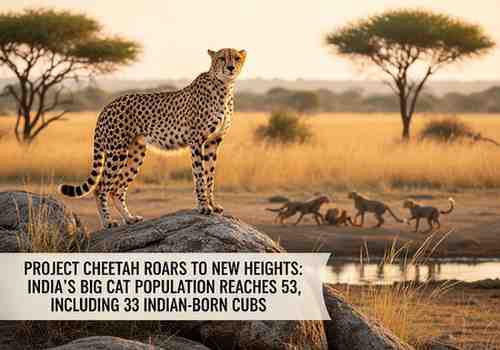
Project Cheetah is one of the most complex wildlife reintroduction projects attempted anywhere in the world. The fact that the population has now more than doubled from the original 20 translocated individuals — including new births — shows the programme is working.
Challenges remain. Some adult cheetahs have died, and moving large carnivores between continents always carries risks. But the rapid breeding, the survival of second-generation cubs, and the expansion into Gujarat and beyond all point in the right direction.
India is once again becoming a country where cheetahs can thrive.
Exam-Focused Points
| Topic |
Key Details |
| Cheetah extinction in India |
Officially declared extinct in 1952 |
| Project Cheetah launched |
17 September 2022 from Namibia (8 cheetahs) |
| Second batch |
February 2023 from South Africa (12 cheetahs) |
| Third batch |
February 2026 from Botswana (9 cheetahs; 6 females, 3 males) |
| Total translocated |
29 cheetahs |
| Total Indian-born cubs |
33 |
| Total cubs born in Kuno overall |
39 (27 surviving as of Feb 2026) |
| Current population |
53 cheetahs (29 adults + 24 cubs approx.) |
| Kuno National Park |
Core hub |
| Gandhi Sagar Wildlife Sanctuary |
First expansion, now 3 cheetahs |
| Nauradehi Wildlife Sanctuary |
Approved as 3rd cheetah habitat in MP |
| Banni grasslands, Gujarat |
Under consideration as a conservation breeding centre |
| Metapopulation framework |
Multiple connected sites to maintain genetic diversity |
| Programme cost |
$11 million over 5 years |
| World’s first |
Intercontinental translocation of a large carnivore |
FAQs
Q1: When did cheetahs become extinct in India?
Ans: The cheetah was officially declared extinct in India in 1952.
Q2: How many cheetahs are in India now under Project Cheetah?
Ans: As of May 2026, the total cheetah population is 53, including 33 cubs born in India.
Q3: Where were the cheetahs brought from?
Ans: They arrived in three batches: eight from Namibia (2022), 12 from South Africa (2023), and nine from Botswana (2026).
Q4: What is the metapopulation framework?
Ans: It is a strategy where multiple separate cheetah populations live in different habitats but are connected through movement and genetic exchange to prevent inbreeding and improve long-term survival.
Q5: Which new locations will host cheetahs?
Ans: Gandhi Sagar Wildlife Sanctuary (already has three), Nauradehi Wildlife Sanctuary (approved as third site), and Banni grasslands in Gujarat (under active consideration).
Month: Current Affairs - May 23, 2026
Category: Environment, Ecology