Overview
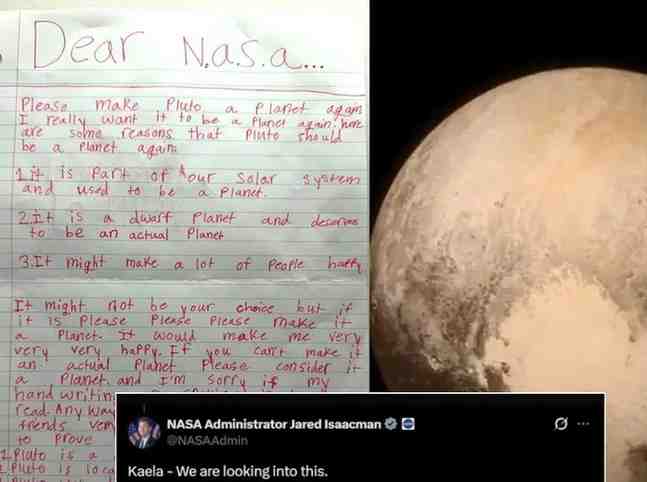
In the discussion of whether Pluto is a planet or not, the issue has re-emerged with a letter written by a 10-year old student being responded to by NASA leadership. Pluto, which used to be the 9 th planet, was classified as a dwarf planet in 2006. This choice transformed the scientific knowledge and the way people saw the solar system and the recent debate demonstrates that the question remains the object of worldwide interest.
Background of Reclassification
Pluto, which was discovered by astronomer Clyde Tombaugh in 1930, was a planet for more than 70 years. In 2006, the International Astronomical Union (IAU) established an official meaning of a planet. Pluto failed to meet one important criterion, thus being reclassified as a dwarf planet. It is now known to belong to the Kuiper Belt, a disc outside Neptune which is filled with icy bodies.
Renewed Public Interest
The matter came back to the spotlight, when a young student asked NASA to rethink the Pluto status. NASA Administrator Jared Isaacman accepted the demand, saying that the issue is under consideration. Even though NASA does not classify planets, the answer has sparked public interest and learning across the globe.
Scientific Criteria Explained
The IAU uses the following three criteria to define a planet: it has to orbit the Sun, it must be massive enough to become almost spherical, and it has to clear its orbit of other objects. Pluto satisfies the first and second criteria but not the third since it shares its orbit with other objects in the Kuiper Belt. This is the most important factor that makes it a dwarf planet.
Scientific and Educational Significance.
The Pluto debate is a good example of how scientific classifications change as new knowledge and observations are gained. It also points to the value of the involvement of the people in science, where interest can lead to a wider discourse. These arguments contribute to the development of our knowledge about planetary science and the arrangement of the solar system.
Exam-Focused Key Points
- In 2006, Pluto was redefined as a dwarf planet by IAU.
- It is located in the Kuiper Belt outside Neptune.
- Fails the “clearing the orbit” criterion.
- There are five moons of Pluto, one of them, Charon.
- The definitions of the planets change as science advances.
Practice Questions (with Answers)
Q1. When was the classification of Pluto as a dwarf planet changed?
Answer: 2006.
Q2. Which organisation defines planetary status?
Response: International Astronomical Union (IAU).
Q3. What is the major criterion which Pluto does not satisfy?
Response: Evicting its orbital neighbourhood.
Q4. In what position is Pluto?
Question: In the Kuiper Belt, outside of Neptune.
Q5. Biggest moon of Name Pluto.
Answer: Charon.
Month: Current Affairs - April 11, 2026
Category: Space Science | Astronomy