DART Impact on Dimorphos Shows Strong Potential for Asteroid Deflection
A recent scientific analysis has shown that Double Asteroid Redirection Test (DART) produced a stronger effect than originally predicted. The spacecraft impact not only changed the motion of a small asteroid in a binary system but also caused a slight shift in the entire system’s orbit around the Sun. These findings highlight the potential of spacecraft impacts as an effective planetary defence strategy to protect Earth from dangerous asteroids.
Target of the DART Mission
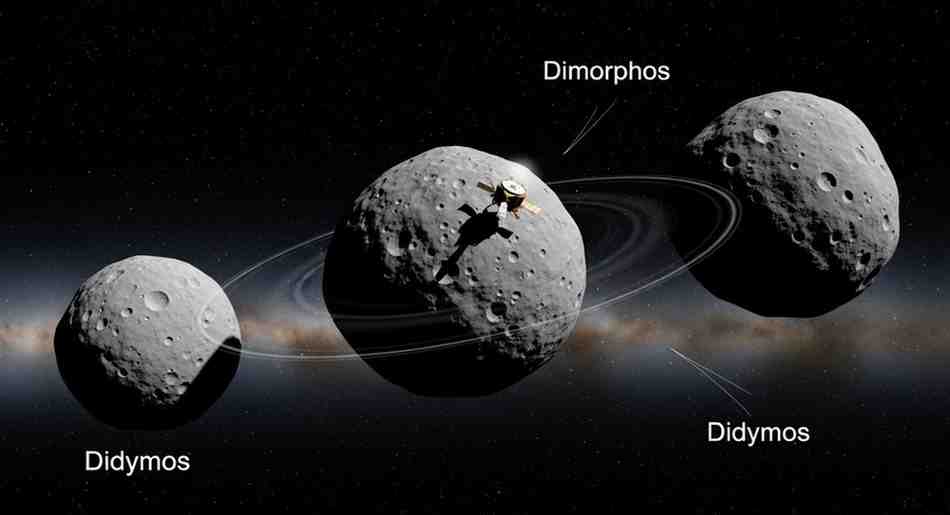
The mission focused on Dimorphos , a small asteroid orbiting a larger body known as Didymos . Dimorphos measures about 170 metres in diameter , while Didymos is approximately 805 metres wide .
Together they form a binary asteroid system travelling around the Sun. Scientists selected this system because it does not pose any threat to Earth , making it an ideal testing ground for asteroid deflection experiments.
The Historic Spacecraft Impact
In September 2022 , NASA deliberately directed the DART spacecraft to collide with Dimorphos at a speed of roughly 22,500 kilometres per hour .
The experiment tested the kinetic impactor technique , a method that involves striking an asteroid with a spacecraft to alter its trajectory. This marked the first real-world demonstration of humanity’s ability to change the motion of a celestial object.
Change in the Asteroid’s Orbit
Before the collision, Dimorphos completed one orbit around Didymos in 11 hours and 55 minutes . After the impact, the orbital period shortened to approximately 11 hours and 23 minutes , representing a reduction of about 33 minutes .
This change exceeded scientists’ expectations and confirmed that the kinetic impact had effectively modified the asteroid’s orbital motion.
Impact on the Entire Asteroid System
Further analysis revealed that the collision also produced a minor shift in the entire Didymos–Dimorphos system’s orbit around the Sun . The system’s orbital period changed by about 0.15 seconds , while its velocity shifted by roughly 11.7 microns per second .
Researchers believe the effect was amplified by a large plume of debris ejected during the collision. This debris acted like a rocket exhaust, increasing the overall momentum transfer. The findings demonstrate that even relatively small spacecraft can create measurable changes in asteroid trajectories.
Exam-Focused Points
-
Double Asteroid Redirection Test (DART) was NASA’s first planetary defence mission .
-
Dimorphos orbits the larger asteroid Didymos .
-
The kinetic impactor method uses a spacecraft to change an asteroid’s trajectory.
-
Dimorphos’ orbital period decreased by about 33 minutes after the impact .
-
Planetary defence focuses on detecting and preventing asteroid or comet impacts on Earth
Month: Current Affairs - March 14, 2026
Category: Science & Technology