India Introduces National Climate Stack Initiative to Improve Climate Data and Forecasting
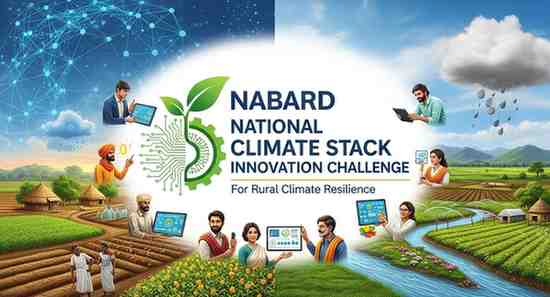
The National Bank for Agriculture and Rural Development (NABARD), in partnership with the Gates Foundation and Dalberg Advisors, has launched the National Climate Stack Innovation Challenge to strengthen climate resilience in India’s rural regions. The initiative aims to create the technological foundation of a National Climate Stack , a digital framework designed to integrate multiple climate datasets and generate actionable climate intelligence for agriculture, rural finance and public policy planning.
Need for Integrated Climate Data Systems
India has been experiencing an increasing frequency of extreme weather events such as heatwaves, floods, droughts and cyclones. These climate risks pose significant challenges for agricultural productivity and rural livelihoods. Although large volumes of climate data are now available, much of the information remains scattered across different platforms and institutions.
The National Climate Stack initiative seeks to address this fragmentation by developing an interoperable and accessible data infrastructure that consolidates climate information into a unified system.
Objective of the National Climate Stack
According to NABARD Chairman Shaji K. V. , climate-related data currently exists in isolated databases, limiting its effective utilisation for decision-making. The proposed Climate Stack aims to integrate diverse datasets, climate models and analytics tools into a seamless technological framework.
Such integration would enable predictive analytics, improved risk assessment and real-time insights for stakeholders such as farmers, financial institutions and policymakers. The initiative aligns with India’s broader efforts to leverage digital technologies for building climate-resilient rural ecosystems .
Focus on Climate Hazard Forecasting
A major component of the Innovation Challenge is the development of near-term climate hazard forecasting models covering a time horizon of 10–15 years . These models will serve as the core layer of the Climate Stack.
Researchers and innovators are encouraged to design forecasting systems capable of predicting climate risks such as droughts, floods and extreme weather events , enabling early preparedness and better policy planning.
Promoting Innovation and Real-World Applications
The initiative also seeks practical digital tools built on the forecasting layer, including interactive dashboards and applications . These tools could support use cases such as climate-informed crop planning, rural credit risk analysis and disaster preparedness strategies .
By linking scientific climate models with practical decision-support systems, the initiative aims to transform raw climate data into usable climate intelligence for governments and rural communities.
Structure and Timeline of the Challenge
The National Climate Stack Innovation Challenge will follow a multi-stage process. An open call for proposals was issued on March 6, 2026 , inviting participation from research institutions, universities, startups and private-sector innovators.
The proposals will undergo screening and shortlisting during March–April 2026 , followed by a six-to-eight-week guided development phase from April to May . Final technical evaluation and jury selection are scheduled for May–June 2026 , with entries assessed on scientific rigour, scalability, interoperability and practical relevance.
Exam-Focused Points
Month: Current Affairs - March 10, 2026
Category: Environment & Climate Change