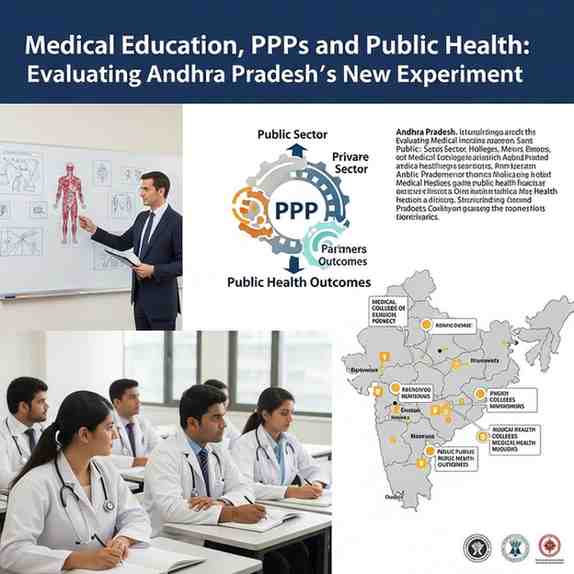
The Andhra Pradesh government’s proposal to expand medical education through public–private partnerships (PPPs) has ignited a wider debate on the purpose of public policy in health, the future of subsidised medical education, and the risks involved in transferring public health assets to private control. At stake is not merely financing, but the State’s long-term capacity to regulate healthcare delivery, protect equity, and ensure an adequate medical workforce for public service.
Expansion of Medical Education: The State’s Recent Push
Over the past three years, Andhra Pradesh undertook a rapid expansion of medical education. Six new government medical colleges were established, raising the total to 17, alongside 19 private colleges. Plans were subsequently announced for 10 additional colleges attached to district hospitals, which would push total MBBS seats beyond 6,500 once fully operational.
Under the previous government, land acquisition of nearly 835 acres was completed, and construction initiated. Each college was planned with 150 MBBS seats and attached to a 650-bed district hospital upgraded to teaching standards. The estimated cost per college was around ₹450 crore, to be financed through a mix of NABARD loans, State funds and central assistance.
The Original Financial Model: Balancing Access and Viability
Government medical colleges traditionally offer heavily subsidised education. To balance affordability with fiscal sustainability, a three-tier fee structure was proposed:
-
50% of seats at ₹15,000 per year
-
35% of seats at ₹12 lakh per year
-
15% NRI quota seats at ₹20 lakh per year
This model aimed to retain a large share of low-fee seats while generating sufficient revenue to support operations. With additional income from postgraduate courses, the system was expected to recover a significant portion of costs without compromising public ownership.
Shift to a PPP Framework
In 2024, the new government commissioned feasibility studies to convert 11 of these colleges into PPP projects. Under the proposed model, private partners would receive the entire medical college and district hospital on a long-term lease of 33 years, extendable to 66 years, at a nominal lease rate.
The State would provide viability gap funding, ensure regulatory clearances, empanel the hospitals under public insurance schemes, and guarantee patient flow. In return, private partners would complete construction within two years, offer free outpatient services, and reserve a majority of inpatient beds for government-referred patients at regulated rates.
Sources of Public Concern
The PPP design has triggered widespread anxiety. Critics argue that effectively handing over district hospitals—core pillars of public healthcare—to private entities risks diluting State control over both medical education and service delivery.
There are fears that affordable access for middle-class and poor students may shrink, while employment opportunities for doctors and staff could become more precarious, as private operators are not bound by public recruitment norms or reservation policies. Patients, particularly from vulnerable groups, worry about informal charges and erosion of free treatment, despite formal safeguards.
Risk Allocation and Regulatory Challenges
A major concern is the asymmetry in risk-sharing. Strict bed earmarking, regulated tariffs and delayed reimbursements may strain private partners, incentivising cost-cutting or selective service provision. If a private operator fails, the State’s remedies are largely legal, risking disruption of essential health services during prolonged disputes.
Long-term leases also constrain policy flexibility. As healthcare delivery evolves—with stronger primary care, shorter hospital stays and more day-care procedures—the relevance of uniform 650-bed hospitals across districts may diminish.
Implications for Public Health and Workforce Availability
Andhra Pradesh already faces shortages of doctors and specialists, especially in rural areas. Commercialising medical education could worsen this imbalance, as high-fee graduates are more likely to pursue urban private practice or migrate abroad.
Instead of selling seats at market rates, many experts argue for expanding subsidised education tied to compulsory public service, which would directly strengthen district-level healthcare capacity.
Beyond Fiscal Constraints: A Question of Governance
Supporters of PPPs cite fiscal stress, but critics note that States have alternative borrowing and financing mechanisms that do not require relinquishing control over public hospitals. Privatisation demands strong regulatory capacity, yet India’s experience in enforcing even basic health regulations has been uneven.
Past experiments with contracted primary healthcare services have exposed weaknesses in monitoring and accountability. In such an environment, transferring strategic public health assets to private hands carries significant equity and governance risks.
A Broader Crisis in Medical Education Quality
India’s medical education system is already strained, with rapid expansion outpacing the availability of qualified faculty. Observers warn that unchecked growth could mirror the decline seen in engineering education, where quantity expanded at the cost of quality.
The central issue, therefore, is not the number of medical colleges, but whether standards, accessibility and public health objectives are preserved.
Conclusion
The Andhra Pradesh PPP proposal raises fundamental questions about the role of the State in health and education. While expanding medical capacity is essential, doing so by diluting public control over district hospitals and medical education may undermine long-term health outcomes.
Medical education is not merely a commercial investment; it is a strategic public good. Any reform must prioritise equity, accountability and workforce availability over short-term fiscal convenience. Without strong regulation and clear public interest safeguards, the current PPP model risks weakening, rather than strengthening, Andhra Pradesh’s public health system.
Month: Current Affairs - Dec 29, 2025
Category: