follow two weeks of darkness.
Extreme lunar temperatures: Equatorial temperatures range from 120°C during the day to -130°C at night. Permanently shadowed polar craters reach -246°C.
Rare Facts for Prelims :
-
Luna 16: First robotic mission to bring lunar soil back without human crew.
-
Queqiao: Relay satellite enabling Chang'e 4 to communicate from the far side.
-
Chandrayaan-1's Moon Mineralogy Mapper: Provided key evidence of hydroxyl and water molecules.
-
SLIM: Demonstrated precision landing technology for difficult terrain.
-
South Pole-Aitken Basin: May expose ancient crustal material.
-
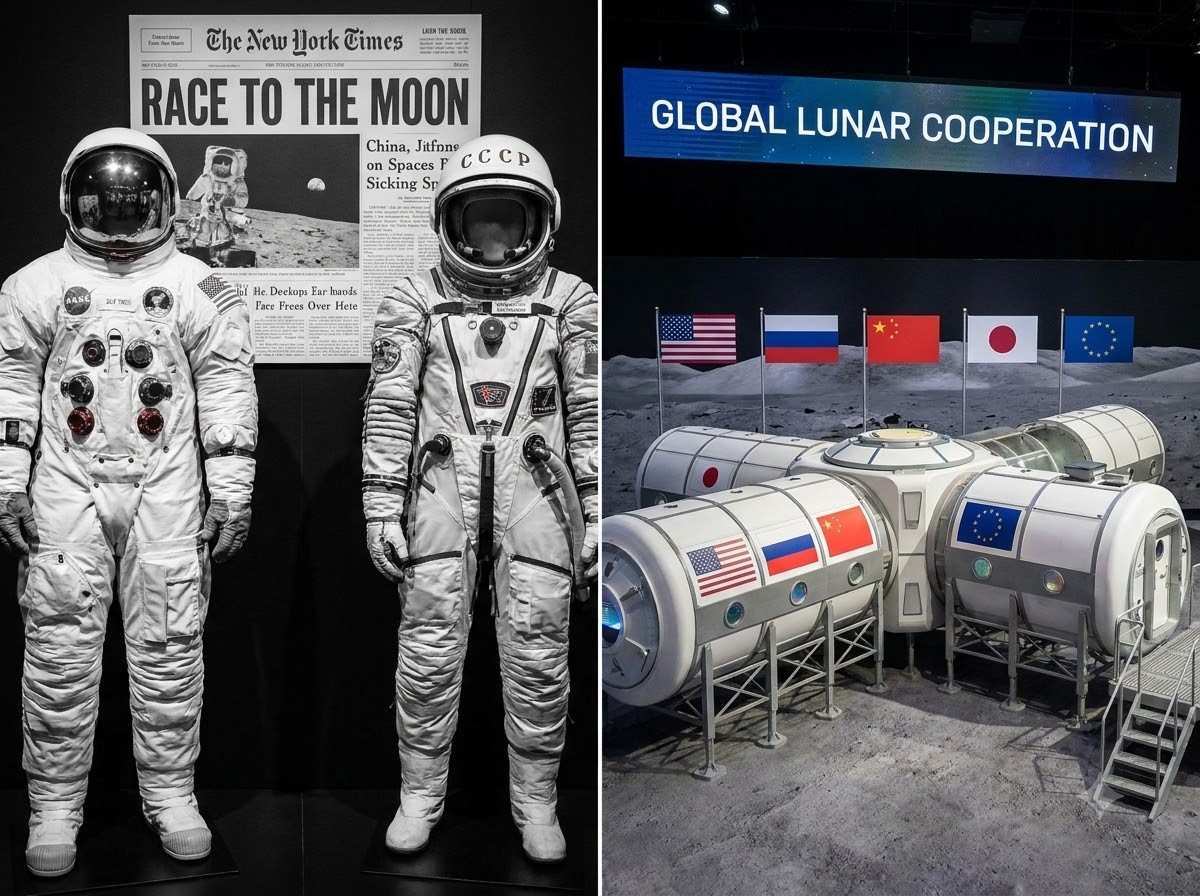
Jinnah-1: Planned for 2029 Chang'e-8 mission – a notable example of international lunar cooperation.
Exam-Focused Points :
-
First Human on Moon: Neil Armstrong (Apollo 11, July 20, 1969).
-
First Soft Landing: Luna 9 (Soviet Union, 1966).
-
First Indian Lunar Mission: Chandrayaan-1 (2008) – confirmed water molecules on Moon.
-
First South Pole Landing: Chandrayaan-3 (India, 2023).
-
First Far Side Landing: Chang'e 4 (China, 2019).
-
First Far Side Sample Return: Chang'e 6 (China, 2024).
-
Pakistan's First Rover: Jinnah-1 (launch planned for 2029 on Chang'e-8).
FAQs :
Q1: Who were the first humans to land on the Moon?
Neil Armstrong and Buzz Aldrin of Apollo 11 landed on the Moon on July 20, 1969.
Q2: Which country first soft-landed on the Moon?
The Soviet Union's Luna 9 achieved the first controlled soft landing in 1966.
Q3: What was Chandrayaan-1's major discovery?
It confirmed the presence of water molecules on the lunar surface.
Q4: Which mission achieved the first far-side sample return?
China's Chang'e 6 (2024) returned samples from the far side for the first time.
Q5: When is Pakistan's Jinnah-1 rover planned for launch?
Jinnah-1 is targeted for launch in 2029 aboard China's Chang'e-8 mission.
Month: Current Affairs - Aug 13, 2026
Category: Space Exploration