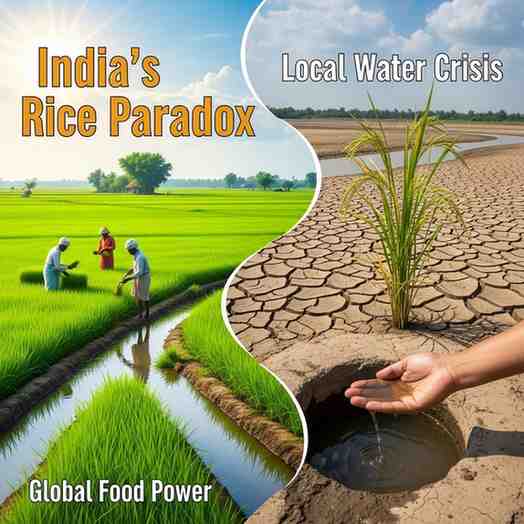
its groundwater reserves are collapsing?
The dilemma is sharpened by India’s global role. Because of its dominance in rice exports, even small changes in Indian production or export policy can trigger price volatility and food insecurity abroad. Sustainability at home thus intersects with responsibility abroad, making reform both urgent and diplomatically sensitive.
Are Policy Shifts Emerging?
There are early signs of course correction. Haryana has offered a subsidy of ₹17,500 per hectare to encourage farmers to shift from rice to less water-intensive crops such as millets. Yet the incentive applies for only one season and has seen limited uptake.
Experts argue that short-term payments cannot offset long-term uncertainty. Research suggests that farmers need multi-year transition guarantees — at least five years — to confidently move away from rice. Importantly, such a shift need not increase overall subsidies. Punjab already spends nearly ₹39,000 per hectare on fertiliser and power subsidies for rice. Redirecting this support toward alternative crops could preserve farmer incomes while sharply reducing water use.
The Larger Question Before India
India’s rice success reflects the triumph of policies designed for an era of scarcity. But in an era of abundance and climate stress, those same policies are generating ecological and economic distortions. The real challenge is not whether India can grow and export rice, but whether it can redesign incentives so that farmers are rewarded for conserving water rather than exhausting it.
This is as much a political challenge as a technical one. Without reform, the costs of India’s rice boom will be paid through depleted aquifers, rising rural debt and a fragile food system. The task ahead is to ensure that India’s global agricultural leadership does not come at the expense of its own ecological future.
Month: Current Affairs - January 02, 2026
Category: