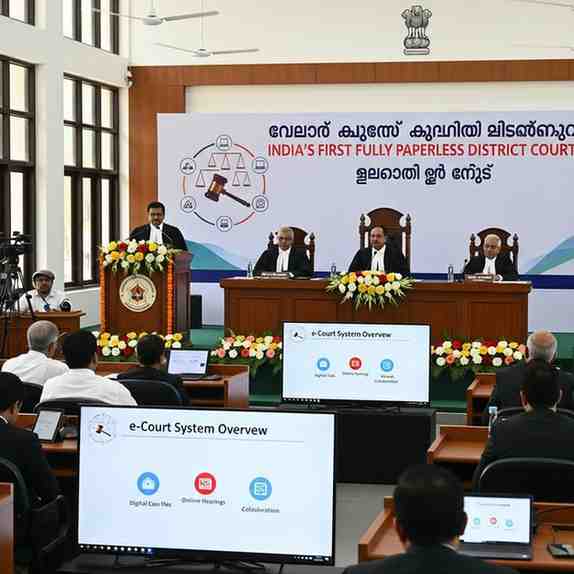
Kalpetta Becomes India’s First End-to-End Digital District Judiciary with AI Tools
India has taken a landmark step in judicial reform with the virtual inauguration of the country’s first fully paperless district judiciary at Kalpetta in Wayanad district, Kerala . The initiative, inaugurated by Surya Kant , marks a decisive shift toward technology-driven, citizen-centric justice delivery and sets a precedent for courts across the country.
End-to-End Digital Courts in Kalpetta
All courts functioning in Kalpetta have now transitioned to complete digital operations , eliminating the use of physical files. From filing to final disposal, every stage of a case is handled electronically.
Case filings are submitted online, scrutinised digitally, and accessed instantly by judges through the District Court Case Management System , an in-house platform developed by the Kerala High Court . The system ensures seamless access to records, faster case movement, and greater transparency.
This digital transformation is expected to significantly benefit ordinary litigants, lawyers, and MSMEs by reducing travel, paperwork, delays, and overall litigation costs—especially in a geographically challenging district like Wayanad.
AI-Enabled Tools Powering the Paperless Judiciary
The new digital courts are supported by a suite of AI-driven tools designed to enhance judicial efficiency. Judges can generate structured summaries from electronic case files, search case-specific details instantly, and digitally annotate documents.
Advanced voice-to-text technology enables accurate transcription of witness depositions and judicial dictation, while secure digital signatures provide full legal validity to orders and judgments. Importantly, the entire ecosystem has been developed internally , without dependence on external proprietary software, ensuring data security and institutional control.
“Shedding the Tyranny of the File”
Addressing the inauguration, the Chief Justice described the transition as more than a technological upgrade—it represents a philosophical shift in justice delivery. He referred to the move as “green jurisprudence” , emphasising that digitisation reduces paper consumption while improving accountability and access.
He noted that every judicial action now leaves a permanent digital footprint , enhancing transparency and reinforcing public confidence in the justice system.
Broader National Significance
Vikram Nath , Chairperson of the Supreme Court eCommittee, termed the initiative a citizen-centric reform that brings justice closer to people. He highlighted that courts have traditionally been among the largest consumers of paper and said the Wayanad model demonstrates how technology can simultaneously reduce the judiciary’s ecological footprint and improve efficiency.
The success of Kalpetta’s paperless courts is expected to serve as a replicable model for other districts and states, accelerating India’s broader eCourts and digital governance agenda.
Why This Reform Matters
By combining digital infrastructure, AI tools, and in-house innovation, the Kalpetta initiative addresses long-standing issues of delay, cost, and accessibility in the justice system. It also aligns judicial reform with sustainability goals, making justice delivery faster, greener, and more transparent.
Quick Facts for Exams
-
Kalpetta (Wayanad, Kerala) hosts India’s first fully paperless district judiciary.
Month: Current Affairs - January 10, 2026
Category: digital transformation