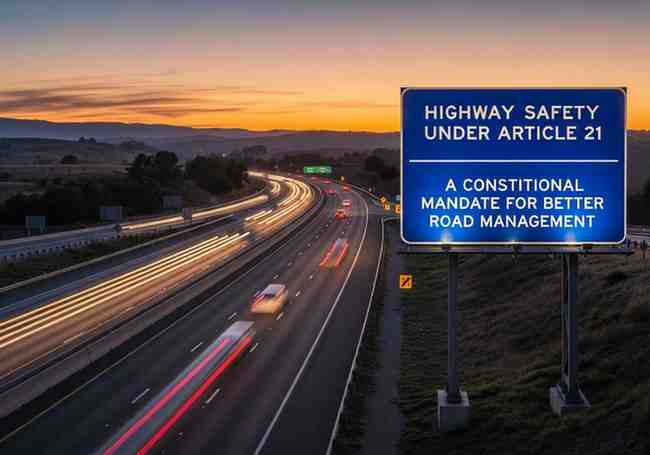
Elevating Road Safety to a Constitutional Right
The Supreme Court of India has delivered a landmark judgment declaring that the right to safe travel on National Highways is an intrinsic part of the fundamental Right to Life guaranteed by Article 21 of the Constitution. Moving away from viewing road safety as merely an administrative chore, the Court elevated it to a strict constitutional duty of the State. Citizens are legally entitled to commute without being subjected to preventable hazards such as poor road conditions, unauthorized structures, or illegal parking.
The Grim Reality of Highway Accidents
A Supreme Court Bench comprising Justices J.K. Maheshwari and Atul S. Chandurkar highlighted a deeply concerning statistic: while National Highways make up a mere 2% of India’s overall road network, they are the site of nearly 30% of all traffic-related fatalities. The Court firmly stated that high-speed expressways must never become death traps due to negligence or weak law enforcement. Every avoidable death caused by accident blackspots, illegal encroachments, or unsafe parking represents a direct failure of governance.
Cracking Down on Encroachments and Roadside Eateries
To combat these preventable dangers, the Court has strictly prohibited the construction and operation of dhabas, eateries, and other unauthorized commercial setups along the Right of Way (ROW) of National Highways. It ordered the immediate removal of existing encroachments to ensure unobstructed visibility, smoother traffic movement, and a reduction in accident risks. Furthermore, local authorities are now barred from issuing fresh licenses or No Objection Certificates (NOCs) for such roadside structures without explicit, prior approval from the National Highways Authority of India (NHAI).
Streamlining Traffic and Emergency Protocols
The judgment places strict restrictions on heavy and commercial vehicles, banning them from parking indiscriminately on highways; they are now restricted to designated truck lay-bys and specific parking bays. To enforce these rules, the Court mandated regular highway patrols, drone surveillance, and a heavier reliance on Automated Traffic Management Systems. Recognizing the crucial "golden hour" in medical emergencies, the ruling requires that ambulances, cranes, and rescue teams be stationed at regular intervals for rapid deployment. District-level Highway Safety Task Forces have also been mobilized to monitor and enforce compliance.
The Broader Impact of the Verdict
By interpreting commuter safety as a basic constitutional right, the Supreme Court has significantly broadened the scope of Article 21. This ruling firmly holds both Central and State governments accountable for developing secure public infrastructure and preventing avoidable tragedies. It lays down a robust legal foundation for driving much-needed road safety reforms across the country.
Important Facts for Exams
-
Constitutional Link: The right to safe travel is now officially recognized under Article 21 (Right to Life and Personal Liberty) of the Indian Constitution.
-
Crucial Data Point: National Highways account for only ~2% of India’s total road length but contribute to nearly 30% of all road crash fatalities.
-
Statutory Body: The NHAI (National Highways Authority of India) is the primary authority responsible for the development, maintenance, and regulation of National Highways.
-
Origin of the Case: The Supreme Court initiated this action suo motu (on its own accord) following two devastating road accidents
Month: Current Affairs - April 27, 2026
Category: Constitutional Law (Article 21)