Image

Recasting Sin Taxes in the GST Era: Why the Centre’s Latest Move Matters

The Union government’s decision to restore excise duty on cigarettes and introduce a machine-capacity-based cess on pan masala marks a significant recalibration of India’s sin-tax framework. Nearly a decade after the rollout of the Goods and Services Tax (GST), this move signals an acknowledgement that the original architecture, while simplifying indirect taxation, left critical gaps in taxing demerit goods. Far from being a routine revenue measure, the reform reflects the State’s attempt to realign fiscal policy with public health, enforcement realities and the post-compensation GST landscape.

Month: 

Category: 

India’s Agriculture 2025: Growth That Reaches the Ground

In 2025, Indian agriculture stood at a critical juncture where growth was no longer confined to macro statistics but increasingly visible at the grassroots. After decades of being characterised by subsistence farming, income uncertainty and climatic vulnerability, the sector reflected the cumulative impact of sustained public investment, policy continuity and institutional reform. Contributing nearly 16% to India’s GDP in FY 2024–25 and supporting the livelihoods of about 46% of the population, agriculture reaffirmed its central role in economic stability, food security and rural transformation.

Month: 

Category: 

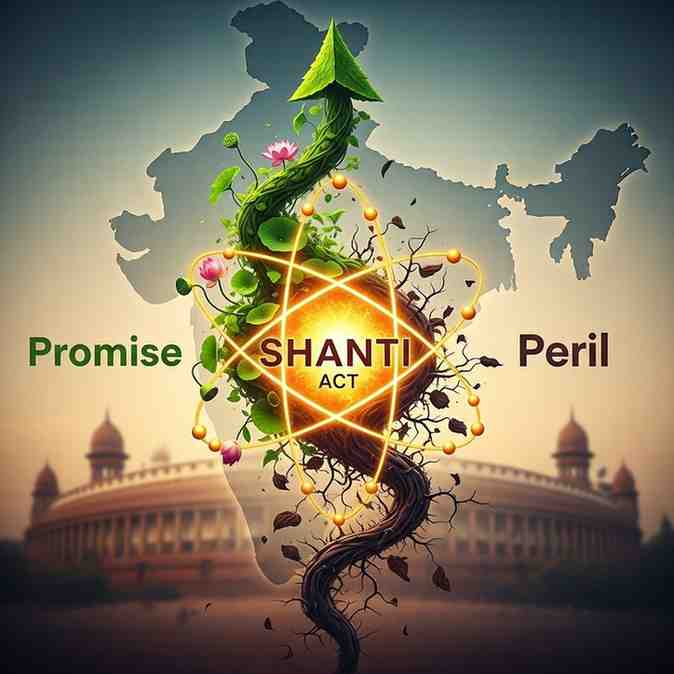
Reforming India’s Nuclear Energy Framework: Promise and Peril of the SHANTI Act

India’s nuclear energy sector is at a historic inflection point. With the enactment of the Sustainable Harnessing and Advancement of Nuclear Energy for Transforming India (SHANTI) Act, the country has undertaken its most consequential reform since the Atomic Energy Act of 1962. For six decades, nuclear power in India remained a state monopoly—strategically insulated, but operationally constrained. The SHANTI Act decisively breaks with this legacy by opening the sector to private participation, reforming civil nuclear liability, and seeking convergence with global regulatory norms. Yet, the Act’s transformative potential will depend not on legislative intent alone, but on how unresolved questions of regulation, liability, and pricing are ultimately settled.

Month: 

Category: 

The “Lazy Bird” in Nature: Why the Cuckoo Is a Master of Survival, Not Idleness

In popular imagination, laziness is often associated with inactivity, lack of effort, or avoidance of responsibility. When this human idea is applied to the natural world, it can be misleading. A classic example is the cuckoo, a bird widely referred to as the “Lazy Bird”. The label arises from the cuckoo’s refusal to build nests or raise its own young. Yet, far from being indolent, the cuckoo represents one of nature’s most sophisticated evolutionary strategies, demonstrating how survival often depends more on intelligence than on hard work alone.

Month: 

Category: 

Pinaka LRGR-120: Precision Firepower and the Evolution of India’s Artillery Doctrine

India’s successful maiden flight test of the 120-km Pinaka Long Range Guided Rocket (LRGR-120) marks an important milestone in the country’s quest for credible, indigenous long-range precision strike capability. Conducted at the Integrated Test Range, Chandipur, the trial demonstrated not only extended reach but also high accuracy, manoeuvrability and system reliability—capabilities that modern battlefields increasingly demand. Beyond the technical success, the test reflects a deeper shift in India’s military doctrine, defence industrial capacity, and deterrence posture.

Month: 

Category: