Communication Lost with One Spacecraft of ESA’s Proba-3 Solar Mission
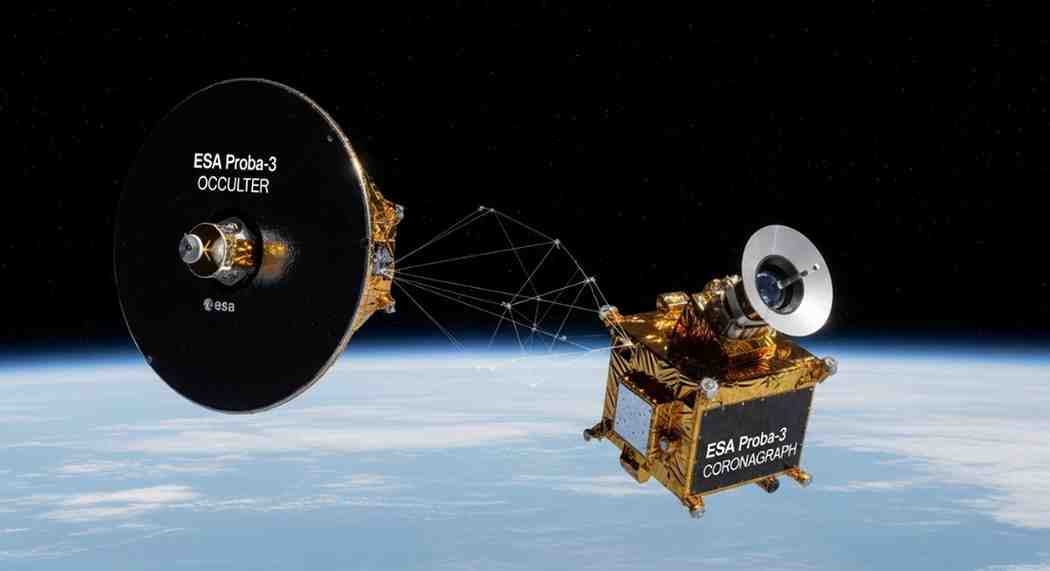
The European Space Agency’s Proba-3 mission , designed to study the Sun’s outer atmosphere, has experienced a significant technical issue after losing contact with one of its two spacecraft. The mission is intended to capture highly detailed images of the solar corona by generating artificial solar eclipses in space. Engineers are currently investigating a malfunction that caused the Coronagraph spacecraft to lose its orientation and break communication with mission control.
Loss of Attitude Control
The anomaly reportedly began in mid-February 2026 when a technical fault triggered a gradual loss of attitude control in the Coronagraph spacecraft. Attitude control systems enable satellites to maintain the correct orientation in space.
Because of the malfunction, the spacecraft’s solar panels were no longer aligned with the Sun , preventing them from producing sufficient electrical power. As the onboard batteries depleted, the satellite entered a survival mode , where only minimal systems remain active. During this mode, communication with Earth is temporarily halted to conserve energy.
Unique Dual-Spacecraft Architecture
The Proba‑3 mission uses a distinctive two-satellite configuration consisting of the Coronagraph spacecraft and the Occulter spacecraft . These satellites operate in precise formation to simulate solar eclipses in orbit.
The Occulter spacecraft blocks the intense light from the Sun’s surface, enabling the Coronagraph spacecraft to observe the faint outer atmosphere. To accomplish this, both satellites must maintain an extremely accurate formation with a separation of roughly 150 metres while orbiting Earth.
Recovery Attempts by Mission Teams
Mission engineers are currently working to restore communication with the malfunctioning spacecraft. The Occulter satellite , which remains fully functional, may be manoeuvred closer to inspect the Coronagraph spacecraft’s orientation. Such observations could help determine the spacecraft’s condition and assist engineers in developing recovery strategies.
Since its launch in December 2024 , the Proba-3 mission has already completed more than 60 successful formation-flying orbits , demonstrating advanced precision-navigation technology for coordinated satellite operations.
Scientific Importance of the Mission
The solar corona , the outermost region of the Sun’s atmosphere, remains one of the least understood parts of the solar system. Observations of the corona are usually possible only during natural total solar eclipses .
Studying the corona helps scientists understand phenomena such as solar winds and coronal mass ejections , which influence space weather. These events can disrupt satellites, communication networks and power grids on Earth , making improved forecasting essential for protecting modern technological infrastructure.
Exam-Focused Points
-
Proba‑3 was launched in December 2024 by the European Space Agency.
-
The mission uses two spacecraft flying about 150 metres apart to create artificial solar eclipses.
-
The solar corona is the Sun’s outermost atmospheric layer , visible during total solar eclipses.
-
Formation
Month: Current Affairs - March 10, 2026
Category: Space Science & Technology