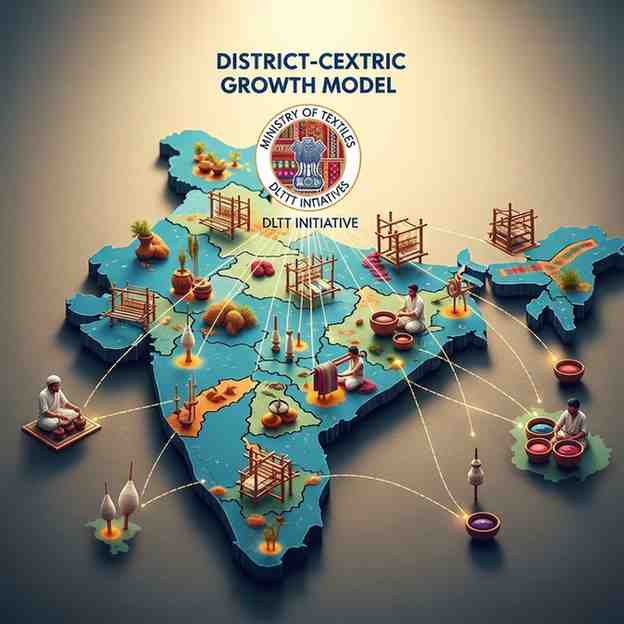
Ministry of Textiles Launches District-Led Textiles Transformation (DLTT) Initiative
The Ministry of Textiles has introduced the District-Led Textiles Transformation (DLTT) initiative, signalling a decisive shift towards decentralised and locally driven textile development. The programme was announced during the National Textile Ministers Conference held in Guwahati , and aims to promote inclusive, competitive, and sustainable growth across India’s vast textile landscape.
A Shift to District-Centric Textile Planning
Unlike earlier nationwide schemes, DLTT adopts a district-focused strategy that recognises the diversity of textile activities across regions. The initiative seeks to develop 100 high-performing districts as Global Export Champions , while simultaneously supporting 100 Aspirational Districts to emerge as self-sustaining textile hubs.
By aligning interventions with district-specific strengths—such as traditional crafts, MSME concentration, or labour availability—the programme aims to ensure balanced regional growth and reduce disparities within the sector.
Data-Based Mapping and District Classification
All districts were evaluated using a structured, data-driven framework built on three core indicators:
-
export performance,
-
strength of the MSME ecosystem, and
-
availability of a skilled and semi-skilled workforce.
Based on this assessment, districts were classified as Champion Districts or Aspirational Districts , enabling differentiated policy support tailored to local maturity levels and growth potential.
Customised Support Models
For Champion Districts , the emphasis will be on scaling up and global competitiveness. Proposed measures include creation of Mega Common Facility Centres, adoption of Industry 4.0 technologies such as automation and digital supply chains, and facilitation of direct access to international markets.
Aspirational Districts , on the other hand, will receive foundational support. Planned interventions include skill development and certification, establishment of Raw Material Banks, and encouragement of micro-enterprises through Self-Help Groups (SHGs) and cooperative models. These measures aim to formalise informal textile activity and build long-term capacity.
Purvodaya Focus and Convergence Approach
A key feature of DLTT is its alignment with the Purvodaya vision, with special emphasis on eastern and northeastern India. The initiative prioritises tribal belt development, improved connectivity, and promotion of Geographical Indication (GI) -tagged textiles and handicrafts to enhance their visibility in global premium markets.
Implementation will rely on convergence of central and state schemes, along with collaboration between government agencies, industry bodies, and academic institutions. Successful district models are expected to be replicated across regions to strengthen India’s textile value chains.
Key Exam-Focused Points
-
DLTT follows a district-level, sector-specific development approach.
-
Districts are categorised into Champion and Aspirational based on data indicators.
-
Industry 4.0 integration is central to upgrading advanced textile clusters.
-
SHGs and cooperatives are key to promoting grassroots textile entrepreneurship.
Month: Current Affairs - January 12, 2026
Category: Industry, MSMEs, Infrastructure