of crucial inputs.
City mining and sustainability.
The other new aspect of Indian mineral policy is urban mining- mining of precious minerals out of electronic and industrial wastes. As e-waste is increasing, this method provides a viable and economical alternative to primary mining.
Urban mining is consistent with the principles of the circular economy, minimizes environmental impact and provides a second domestic resource base. When scaled right, it will be able to considerably decrease the reliance on imports but also solve waste management problems.
Difficulties and the future.
In spite of these good newses, there are still a number of challenges. The mining industry in India is still plagued by land acquisition, environmental clearance and fragmentation of regulation between Centre and States. Value addition is further limited by technological constraints in deep-seated exploration, and insufficiency of processing capacity.
In addition, one should not find only raw material securities as the answer. The creation of a full value chain; extraction to processing and manufacturing is crucial to reap the economic advantages and increase competitiveness.
Conclusion
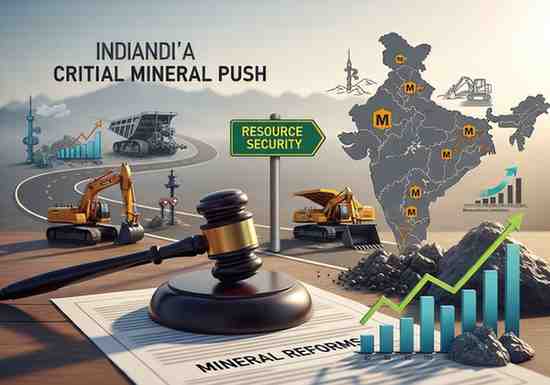
India shift towards critical mineral security is an attempt at strategic repositioning in regards to global economic and geopolitical changes. The country is establishing a platform of resource resilience through increased auctions, policy reforms, global collaborations and sustainable methods of resource exploitation such as urban mining.
The actual mineral security will however not be realized unless there is a long-term process towards elimination of structural bottlenecks, investment in technology and institutional coordination. With the country being aimed at its vision Viksit Bharat 2047, control of critical minerals will be the centre of interest in its goal to become a self-reliant and globally competitive economy.
Month: Current Affairs - April 14, 2026
Category: