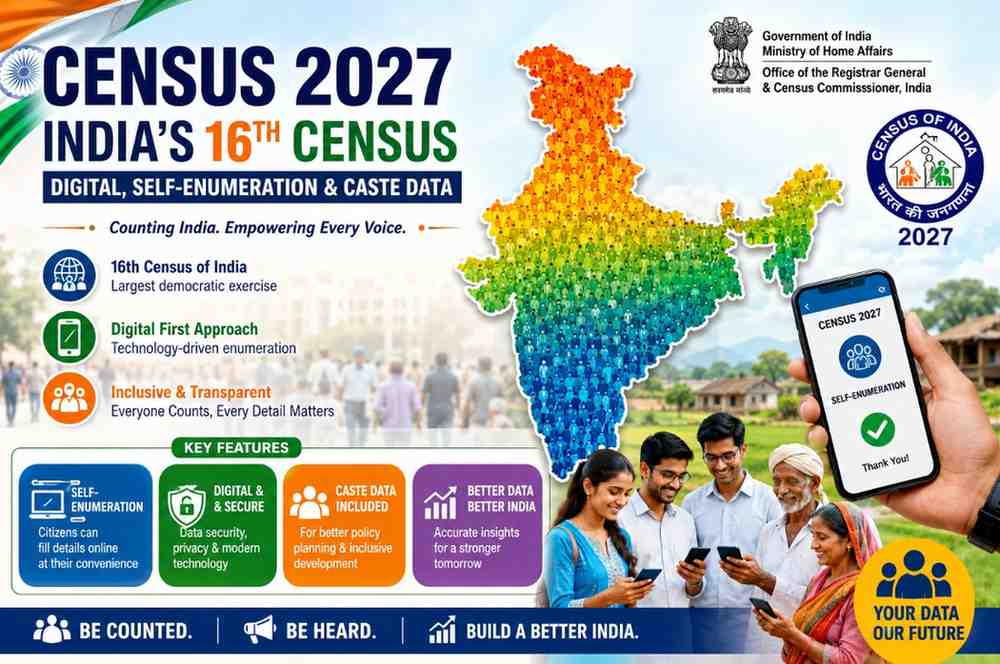
completed; Census 2027 is still upcoming.
Digital Technology – In 2011, only selected processes were digitised; for 2027, an expanded digital framework will be implemented across the operation.
Self-Enumeration – This option was not available in 2011, but it will be introduced in 2027, allowing respondents to fill in their own details.
Caste Enumeration – Caste data was not collected in 2011; however, the 2027 census will include caste enumeration for the first time since 1931.
Population Data – Census 2011 recorded over 121 crore people; Census 2027 will collect updated population figures.
Data Collection Method – The 2011 census relied on traditional field enumeration by enumerators, whereas the 2027 census will utilise mobile and digital systems for data gathering.
Exam-Focused Points :
-
Census 2027: 16th Census of India; 8th since Independence.
-
Previous Census: 2011 was the 15th and last completed census.
-
First Census Exercise: 1872 (non-synchronous); First synchronous: 1881.
-
1921 Census: Known as the "Year of Great Divide" due to population decline.
-
1931 Census: Last British-era census with detailed caste-related data.
-
Conducting Authority: Office of the Registrar General and Census Commissioner, India (Ministry of Home Affairs).
-
Key Features: Digital census, self-enumeration, and caste enumeration.
FAQs :
Q1: Which Census number is 2027?
It is India's 16th Census and the 8th Census since Independence.
Q2: When was the first Indian Census held?
1872 – but it was not synchronous. The first synchronous census was in 1881.
Q3: Why is there a gap between 2011 and 2027?
The 2021 Census could not be conducted due to the COVID-19 pandemic.
Q4: What is new about Census 2027?
It introduces digital data collection, self-enumeration, and includes caste enumeration.
Q5: Who conducts the Census in India?
The Office of the Registrar General and Census Commissioner, India, under the Ministry of Home Affairs.
Month: Current Affairs - Aug 19, 2026
Category: Census 2027