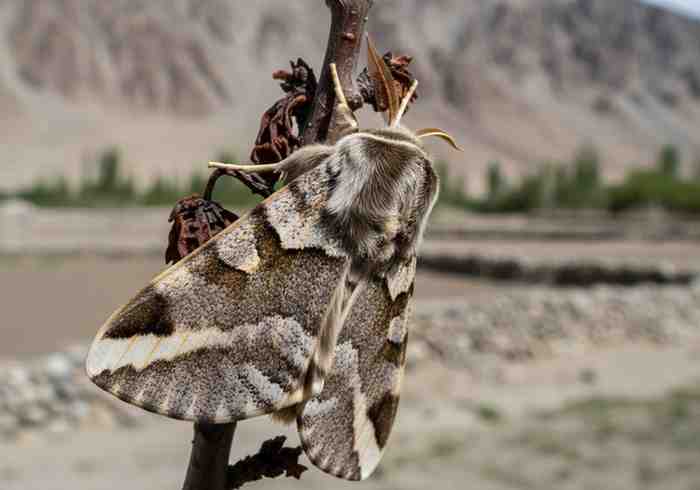
Short Overview
The buff-tip moth ( Phalera cf. bucephala ) has become an agricultural concern in Ladakh, India's cold desert region. This moth belongs to the Lepidoptera order. Its larvae (caterpillars) feed on crops. Ladakh's farming depends on a very short growing season and limited water. Even small pest attacks can cause big losses for local farmers.
What Is the Buff-Tip Moth?
The buff-tip moth is an insect species. Its scientific name is Phalera cf. bucephala . The "cf." part means "compare with." Scientists use it when they are not 100% sure about the identification. They believe this is the right species, but they need more proof.
This moth belongs to the:
Why Is It Called Buff-Tip Moth?
Adult moths have a special look. Their wing tips are pale and buff-coloured. "Buff" means a light brownish-yellow shade. This colour helps the moth hide. When it rests on tree bark or branches, predators cannot see it easily. So the name comes from its appearance.
Where Is Ladakh and What Is Its Farming Like?
Ladakh is a high-altitude cold desert. It lies in the Trans-Himalayan region of India. The main districts are Leh and Kargil.
Farming in Ladakh is very hard. The growing season is very short. Farmers only get a few months of warm weather. They use water from melting glaciers, springs, and small irrigation channels.
Main crops grown in Ladakh:
-
Barley
-
Wheat
-
Peas
-
Vegetables
Because the season is so short, farmers cannot afford any crop loss. Every plant matters.
Why Is This Moth a Concern for Ladakh?
The buff-tip moth has been linked with agricultural problems in Ladakh. The real damage comes from its larvae . Larvae are caterpillars. These caterpillars eat leaves, stems, and flowers of plants. When they feed on crops, the plants become weak. They may not produce grains or vegetables.
In normal farming areas, one pest attack may not be a disaster. But in Ladakh, the growing window is very tight. If caterpillars eat crops early in the season, there is no time to grow new plants. This can mean no harvest for the whole year.
How Do Farmers and Scientists Monitor This Pest?
Pest monitoring in mountain farming includes three simple steps:
-
Field surveys – Walking through fields and looking for insects or damaged leaves.
-
Species identification – Finding out exactly which pest is present.
Month: Current Affairs - May 08, 2026
Category: Agriculture, Ecology