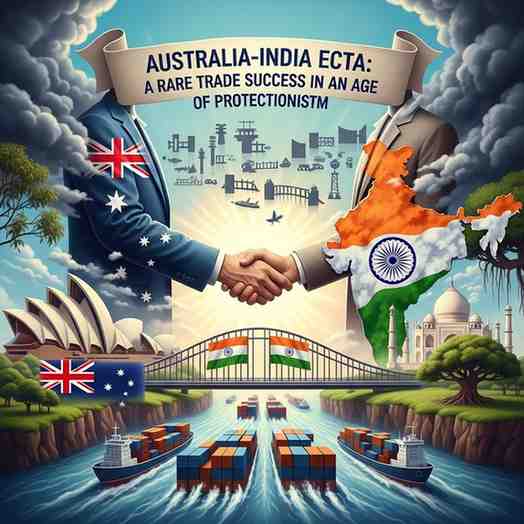
For India, Australia has emerged as a reliable, rules-based partner in the Indo-Pacific — not just a supplier of commodities, but a long-term economic collaborator aligned with India’s manufacturing and growth ambitions. For Australia, deeper integration with India diversifies trade away from excessive dependence on a single market and positions it within Asia’s fastest-growing large economy.
From ECTA to CECA: deepening the partnership
The journey does not end with ECTA. Both sides are now working to upgrade the agreement into a Comprehensive Economic Cooperation Agreement (CECA). While ECTA focused primarily on goods, CECA is expected to expand cooperation across services, investment, digital trade, education, mobility and critical-mineral supply chains.
Australia has already released a dedicated roadmap for economic engagement with India, explicitly framing its strategy around India’s long-term rise as a manufacturing, consumption and innovation hub. This forward-looking approach suggests that ECTA is being treated not as a transactional deal, but as the foundation of a strategic economic partnership.
A template for India’s future trade policy
ECTA may not dominate daily headlines, but its impact is structural. It has delivered tariff-free access, accelerated exports, created employment and built trust at a time when global trade cooperation is weakening.
For India, the agreement offers a template for future trade deals: pragmatic rather than ideological, phased rather than abrupt, and anchored in economic complementarity rather than abstract liberalisation. For Australia, it represents a long-term bet on India’s ascent.
Three years on, ECTA demonstrates that even in an age of uncertainty, well-designed partnerships can still deliver shared prosperity — and that India’s trade future in the Indo-Pacific is not hypothetical, but already unfolding.
Month: Current Affairs - January 03, 2026
Category: