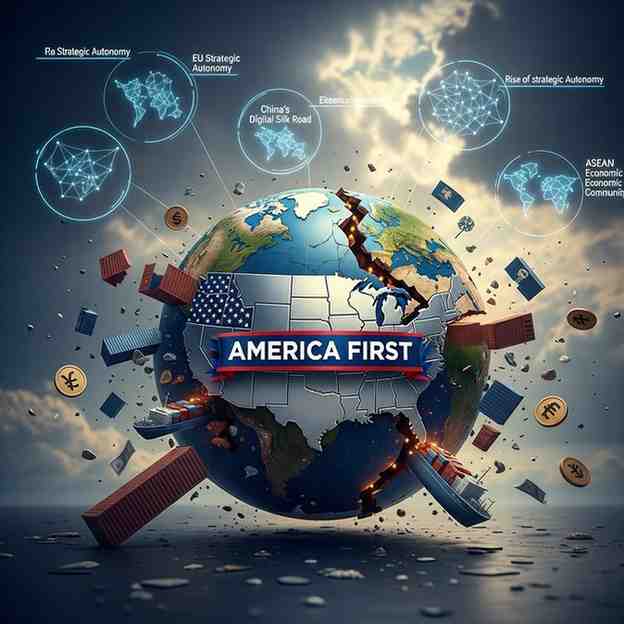
Reducing Dependence on the U.S. Market
Trump’s tariff shock accelerated a global reassessment of export dependence. China, already reducing its reliance on the U.S. since Trump’s first term, saw its export share to the American market fall from nearly 22% in 2017 to around 10% by late 2025. India followed a similar path, cutting U.S. dependence from about 23% to 20% within months.
India also moved swiftly to diversify. A flurry of free trade agreements concluded in 2025, alongside engagement with the Eurasian Economic Union during President Vladimir Putin’s December visit, reflected a deliberate strategy to avoid over-reliance on any single major economy.
Toward Strategic Autonomy
What the America First Trade Policy ultimately exposed was the fragility of an order built on assumptions of U.S. stewardship. As Washington weaponised trade, other powers did not fall in line; they hedged. Diversification, regional partnerships and renewed engagement among emerging economies became tools of resilience.
For India, 2025 reinforced a long-held belief: strategic autonomy is not merely diplomatic rhetoric, but an economic necessity. As the global trade order fractured, emerging powers began not just reacting to shocks, but actively designing alternatives.
In that sense, 2025 may be remembered as more than a year of disruption. It marked the moment when the unipolar assumptions of global trade finally gave way — and when the search for a more plural, autonomous economic order truly began.
Month: Current Affairs - January 02, 2026
Category: