Overview
China’s Chang’e-7 lunar exploration mission is scheduled for launch in the second half of 2026. The mission will study the Moon’s south pole through environmental and resource surveys. It will focus on permanently shadowed regions and possible water ice deposits. Chang’e-7 will use an orbiter, a lander, a rover, and a small hopping spacecraft. The mission is part of China’s long-term plan to build an International Lunar Research Station at the south pole by 2031. A crewed lunar landing is targeted by 2030.
Latest News: Chang’e-7 Launch Set for Late 2026
China is preparing for its next big step in lunar exploration. The Chang’e-7 mission will launch in the second half of 2026. Its destination is the Moon’s south pole. This region has never been fully explored. Scientists believe it may hold water ice in permanently shadowed craters. Finding water on the Moon would be a game changer. It could be used for drinking, oxygen, and rocket fuel. Chang’e-7 will help prepare for a future human base on the Moon.
Mission Profile: Orbiter, Lander, Rover, and Hopper
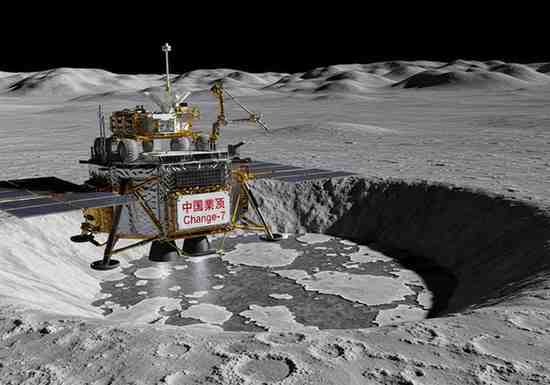
Chang’e-7 is not a single spacecraft. It is a set of four vehicles working together. The orbiter will circle the Moon and relay communications. The lander will touch down on the surface. The rover will drive around and explore. The hopping spacecraft is special. It can land, take off, and hop to another location. This allows it to enter deep, dark craters that other vehicles cannot reach. The mission is designed for high-precision landing. The target accuracy is better than 100 metres. This is much more precise than earlier missions.
Preferred Landing Site: Shackleton Crater
The preferred landing site for Chang’e-7 is the rim of Shackleton crater . This crater is located at the lunar south pole. It is one of the best-known impact craters in that region. The rim offers a good balance of sunlight and access to permanently shadowed areas inside the crater. These shadowed areas are very cold and never see sunlight. They could preserve water ice for billions of years.
Scientific Objectives: Hunting for Water Ice
The main goal of Chang’e-7 is to search for water ice and other volatile substances in permanently shadowed regions. Volatiles are chemicals that freeze at very low temperatures. They include water, carbon dioxide, and ammonia. Finding them on the Moon would be very valuable. The mission will also assess the area for a future research base . Scientists want to know if the south pole is a good place for astronauts to live and work.
Payloads and International Partners
Chang’e-7 carries 18 science payloads in total. Some of these instruments are built with international partners. The Egyptian Space Agency and the Bahrain National Space Science Agency are among the collaborators. This shows China’s openness to global cooperation in space exploration. The data from these instruments will be shared with the international scientific community.
Chang’e-8: The Next Step in 2028-2029
China’s lunar exploration does not stop with Chang’e-7. The next mission, Chang’e-8 , is planned for launch around 2028 or 2029. This mission will continue south pole investigations. But it will also test in-situ resource utilisation (ISRU) . ISRU means using local materials for construction or production. For example, Chang’e-8 will test
Month: Current Affairs - May 24, 2026
Category: Science - Technology, Space